

Solving Kiosk, Robotics & Intercom Acoustic Challenges: The HK-DXMIC-V1.1-8 Array Microphone Module Application Guide
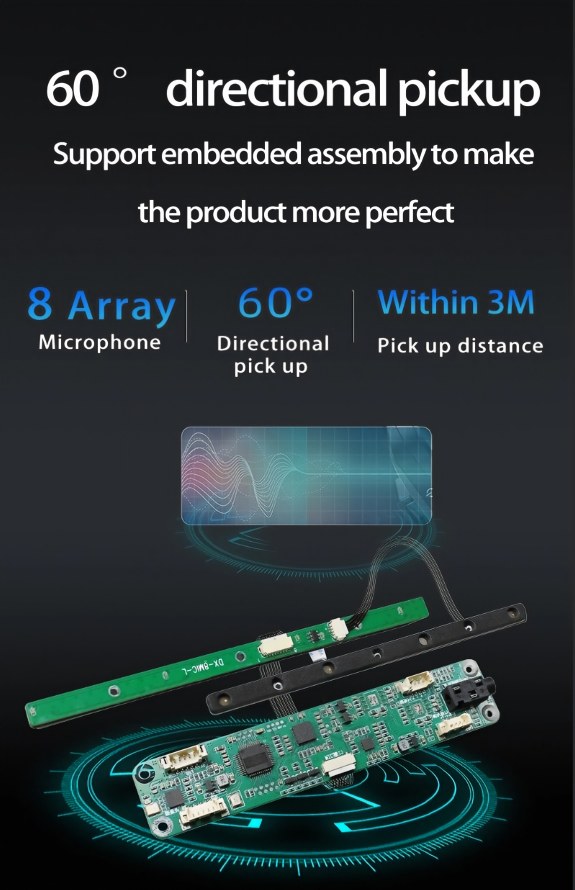
A definitive technical examination of how an 8-element linear beamforming array with 60° narrow directional pickup, hardware Acoustic Echo Cancellation (AEC), and adaptive Automatic Gain Control (AGC) resolves far-field acoustic interference, room reverberation, and voice recognition failures in modern automated terminals.
1. Executive Product Overview & Acoustic Architecture
In voice-driven human-machine interfaces (HMI), standard omnidirectional or dual-microphone solutions consistently struggle when deployed in reverberant, open-air, or crowded environments. The HK-DXMIC-V1.1-8 array microphone module is an industrial-grade, far-field voice processing module purpose-built to solve these acoustic challenges at the hardware level before raw audio ever reaches the host speech recognition (ASR) engine.
Core Algorithmic Pipeline of the HK-DXMIC-V1.1-8:
| 60° Spatial Beamforming 8 calibrated microphones utilize high-order phase delay-and-sum algorithms to establish a tight ±30° frontal listening cone, discarding lateral sound | Multi-Path AEC Engine Subtracts internal loudspeaker loopback audio in real time with >45 dB ERLE, unlocking seamless full-duplex communication and user barge-in. | Adaptive Intelligent AGC Continuously normalizes vocal levels across a 0.3m distance envelope, clamping loud bursts while boosting low-volume speech. |
Industrial Application Scenarios: Where the HK-DXMIC-V1.1-8 array microphone module Excels
Engineered specifically for mission-critical B2B hardware integration where acoustic noise undermines operational efficiency.
Smart Self-Service Terminals & Interactive AI Kiosks (Retail, Transit, Banking)
Public environments such as railway ticketing halls, airport check-in counters, and fast-food quick-service restaurant (QSR) kiosks exhibit heavy ambient acoustic clutter ranging between 70 dBA and 82 dBA. Unfocused microphones capture cross-talk from neighboring customers, frequently triggering incorrect menu selections or failed payment authentications.
The HK-DXMIC-V1.1-8 array microphone module Advantage: The 60° directional pickup pattern acts as an acoustic tunnel centered strictly on the user directly facing the screen. Lateral speech from passersby or adjacent ordering stations is attenuated by over 20 dB. Simultaneously, the onboard hardware AEC cancels the kiosk’s own audio prompts, enabling customers to talk over prompts (barge-in) without stutter or cancellation.
Judicial Courtrooms, Police Interrogation & Legal Deposition Suites
In legal and interrogation settings, the stakes of audio recording could not be higher. Room acoustics are typically hostile: high ceilings, reflective marble or hardwood tables, and glass viewing partitions create long reverberation times. Furthermore, speakers range from subdued, trembling witnesses to abrupt, agitated verbal outbursts.
The HK-DXMIC-V1.1-8 array microphone module Advantage: The module’s Automatic Gain Control (AGC) maintains linear vocal intelligibility by boosting low-volume whispered confessions while clamping loud spikes to prevent clipping. When placed in front of witness and interrogation stations, the 60° cone isolates individual testimony from typing court reporters and HVAC hum, providing certified court-admissible audio archives.
Executive Conference Podiums & Smart Lectern AV Systems
Traditional lectern gooseneck microphones visually obstruct speakers, pick up unwanted vibrations from paperwork shuffling, and cause severe volume drops if the keynote speaker turns away or steps backward.
The HK-DXMIC-V1.1-8 array microphone Advantage: Replacing the gooseneck with an embedded HK-DXMIC-V1.1-8 array allows clean flush-mounting inside the lectern. The 60° forward beam captures the presenter’s torso and head area, while the dynamic AGC automatically compensates for distance shifts between 0.5m and 3.5m. Hardware AEC ensures hybrid video participants can be heard through hall loudspeakers without creating audio feedback loops.
Healthcare Isolation Wards, Telemedicine & Cleanroom Intercoms
Medical environments demand strict asepsis. Handheld microphones or physical push-to-talk buttons represent severe cross-contamination vectors. Additionally, medical staff communicate through thick PPE respirators and acrylic isolation windows in rooms dominated by ventilation airflow and medical monitor alarms.
The HK-DXMIC-V1.1-8 array microphone Advantage: Provides completely touchless, full-duplex conversational intercom. The module’s AEC prevents the acoustic howling typical of glass-window intercoms, while the 60° pickup beam and speech-formant AGC restore intelligibility to muffled mask-covered speech without picking up background equipment hum
AI Service Robotics & Autonomous Delivery Machines
Mobile autonomous robots suffer from intense internal noise: drive motors, cooling fans, and wheel vibration resonate through the chassis. When a human commands the robot across a hotel lobby or warehouse, the robot’s voice front-end often fails to detect the wake-word.
The HK-DXMIC-V1.1-8 Advantage: Spatial filtering steers acoustic nulls directly toward the chassis interior, rejecting motor noise by up to 17 dB. With onboard AEC, the robot can recognize voice commands even while simultaneously speaking answers through its onboard speaker.
Acoustic Engineering Q&A: Architectural Inquiries (FAQ)
Q1:What is the specific acoustic advantage of an 8-array microphone over traditional 2- or 4-mic arrays?
An 8-element array provides significantly higher spatial resolution and directivity index, enabling a sharp 60° main lobe with deeper off-axis null attenuation (-20 dB+).
Engineering Detail: In microphone array engineering, spatial directivity and beamforming precision scale directly with the number of sensor elements and total aperture length. While 2-mic or 4-mic arrays are constrained to broad cardioid or ~120° pickup envelopes with shallow sidelobe rejection, the HK-DXMIC-V1.1-8 utilizes 8 matched precision capsules. This allows the DSP to calculate higher-order phase delay-and-sum algorithms, creating a knife-edge 60° beam. Off-axis acoustic energy outside this 60° corridor experiences -18 dB to -24 dB attenuation, virtually silencing surrounding cross-talk and room reflections.
Q2:How does the 60° directional pickup cone benefit voice recognition (ASR) in noisy public environments?
It acts as an acoustic spatial filter, drastically boosting the Signal-to-Noise Ratio (SNR) and lowering Automatic Speech Recognition (ASR) Word Error Rate (WER) by up to 35%.
Engineering Detail: Automatic Speech Recognition (ASR) engines and large language model (LLM) voice interfaces require high acoustic purity in the 300 Hz – 8 kHz speech band. In noisy environments (such as shopping malls or train stations reaching 75 dBA), standard omnidirectional microphones capture ambient noise alongside the user voice, causing ASR failure. The HK-DXMIC-V1.1-8 mechanically and algorithmically blocks sound sources outside the 60° cone, preventing background conversations from polluting the input stream and preserving speech formant structure.
Q3:How does Automatic Gain Technology (AGC) work in the HK-DXMIC-V1.1-8 across varying speaker distances?
The onboard AGC continuously evaluates incoming vocal root-mean-square (RMS) energy, dynamically scaling digital gain to maintain a standardized -3 dBFS output 0.3m .
Engineering Detail: The HK-DXMIC-V1.1-8 integrates an intelligent DSP-based Automatic Gain Control (AGC) pipeline with rapid attack time (<15 ms) and transparent decay time (<250 ms). If a user stands 0.5 meters away and speaks loudly, the AGC applies dynamic gain attenuation and soft-knee peak limiting to prevent THD saturation and clipping. Conversely, when a speaker is 3 meters away or speaks in a subdued whisper, the AGC transparently lifts the gain without elevating the background noise floor.
Q4:What is Acoustic Echo Cancellation (AEC) and why is it essential for AI voice kiosks and video intercoms?
AEC strips out the terminal’s own loudspeaker audio from the microphone stream, enabling true full-duplex conversation and user barge-in capability.
Engineering Detail: In interactive voice kiosks, robotics, and smart podiums, the device’s loudspeaker frequently plays prompts, remote caller audio, or synthesized speech at high sound pressure levels (SPL). Without AEC, this speaker output loops back into the microphone, triggering loud acoustic feedback howl, echo, and ASR self-triggering. The HK-DXMIC-V1.1-8 DSP runs a high-speed adaptive finite impulse response (FIR) filter that takes the speaker reference signal, models room acoustic reflections, and subtracts the echo with >45 dB Echo Return Loss Enhancement (ERLE).
Q5:How does the HK-DXMIC-V1.1-8 interface with host hardware and operating systems?
It supports standard driverless USB (UAC 1.0/2.0) for instant plug-and-play with Windows/Linux/Android, as well as direct I2S digital audio for embedded SOCs.
Engineering Detail: Engineered specifically for OEM system integrators, the HK-DXMIC-V1.1-8 provides dual connectivity options. In standard PC, kiosk, and smart terminal applications, it connects over USB 2.0 as a standard USB Audio Class (UAC) device requiring zero proprietary drivers across Windows, Linux, Android, and macOS. For low-power embedded designs, IoT devices, or robotics running on microcontrollers and embedded Linux SBCs (Rockchip, NXP, Raspberry Pi), it features direct I2S/TDM digital audio output pins.
Q6:Can the HK-DXMIC-V1.1-8 Array Microphone Module be customized for specific mechanical enclosures or acoustic porting?
Yes. HAOKAI provides comprehensive acoustic chamber guidelines, sound port sealing gaskets, and DSP tuning parameters tailored to OEM enclosure geometry.
Engineering Detail: Acoustic array performance depends heavily on enclosure acoustic design. HAOKAI offers technical consultation for the HK-DXMIC-V1.1-8, including recommended sound port diameter-to-depth ratios, silicone sealing gasket durometers to eliminate internal cavity resonance, and custom DSP parameter flashing (adjusting beam directivity angle, noise gate thresholds, and AGC curve targets) to meet strict client specifications.
Q7:Where can system integrators review detailed technical datasheets and procure sample units for the HK-DXMIC-V1.1-8?
System integrators and hardware design engineers can visit the official HAOKAI product page at https://haokaimic.com/products/hk-dxmic-v1-1-8 to review detailed technical specifications,and electrical characteristics (operating voltage, power consumption) of the HK-DXMIC-V1.1-8. For custom requirements, evaluation sample orders, or technical support, please contact our engineering team via email at [email protected]
You May Also Like

Precision Audio Capture: Exploring the HAOKAI M20 Directional Microphone Array
In modern acoustic environments—from open-plan offices and hybrid meeting spaces to customer service desks—ambient noise and off-axis audio reverberation remain...
HK-M40 Array Microphone — Elevating Voice Clarity for Smart Interactions
HAOKAI Unveils HK-M40 Array Microphone: Empowering AI Voice & Smart Office Ecosystems with Far-Field Audio Capture Leading acoustic solutions provider HAOKAI has officially...