

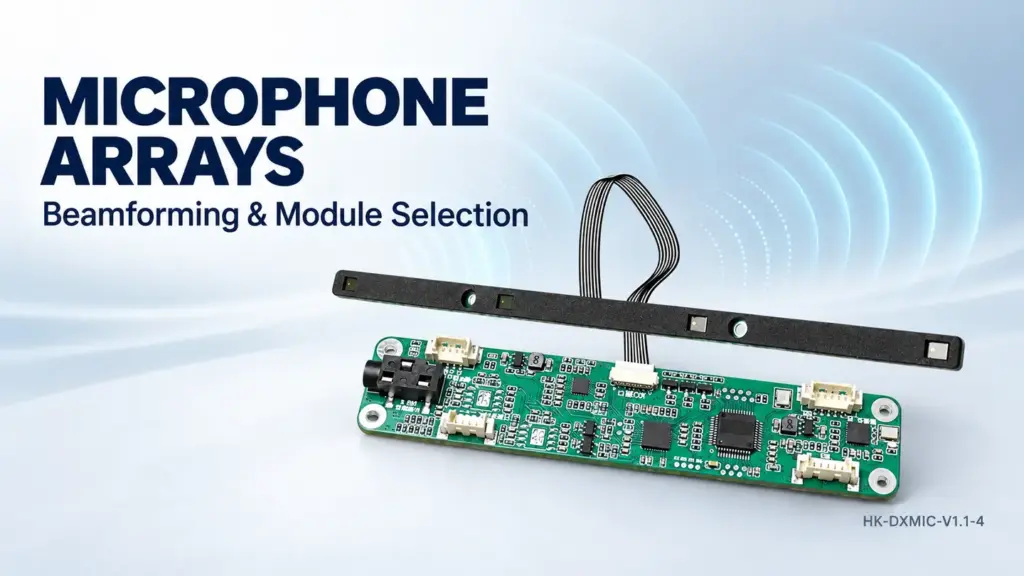
Microphone Arrays: How Beamforming Works and How to Choose the Right Module
A voice-enabled product needs to capture the intended speaker clearly enough for a person or speech recognition system to understand, even when background noise, loudspeaker playback, and room reflections compete with the voice.
Microphone arrays use multiple microphones in a defined spatial arrangement to capture acoustic information. Beamforming processes those signals to emphasize sound from a chosen direction and reduce interference from other directions. The array provides the hardware; beamforming provides spatial filtering.
For conferencing systems, AI kiosks, service robots, and interactive displays, selecting the right array requires decisions about coverage, processing, connectivity, and the final enclosure. The HAOKAI microphone array product catalog includes modules for these different integration needs.
1. Start with the listening task
Before comparing microphone counts or pickup distances, define what the device needs to hear.
| Listening task | Starting point | Main evaluation priority |
|---|---|---|
| Capture a person standing in front of a kiosk | Directional array | Speech clarity within the intended interaction zone |
| Support participants around a meeting table | Omnidirectional coverage | Consistent intelligibility across seating positions |
| Develop custom localization or beamforming software | Synchronized raw multichannel array | Channel access, timing consistency, and calibration |
| Combine voice interaction with video capture | Integrated microphone and camera module | Audio coverage, camera framing, and host compatibility |
These are starting points for evaluation. Select a module through testing in the intended device and acoustic environment. Define whose voice must remain intelligible, from which positions, and while what other sounds are present.
2. How do audio beamforming microphone arrays work?
Speech reaches microphones at slightly different times because each microphone occupies a different position.
A delay-and-sum beamformer compensates for the expected arrival-time differences associated with a target direction, then combines the signals. Properly aligned target speech adds constructively. Signals from other directions combine differently, creating a directional response.
Adaptive beamformers adjust their weights using information from the received sound field. Approaches such as minimum variance distortionless response, or MVDR, seek to reduce interference while preserving the target response. Their effectiveness depends on the accuracy of the signal model and operating conditions.
A beamforming array microphone behaves like a spatially selective listening system. Its performance depends on both physical design and signal processing.
For product evaluation, ask:
- Is the pickup direction fixed, steerable, or automatically selected?
- Does the system support one output beam or multiple simultaneous outputs?
- How does it behave when the speaker moves?
- What happens when another person speaks nearby?
A narrow beam does not solve every interference problem. A competing voice close to the target direction can remain difficult to separate.
3. Why array geometry and microphone matching matter
Microphone count describes only one part of an array. The physical arrangement determines which spatial information the system can capture. The processing must use a geometry model that matches the actual microphone positions.
| Geometry | Integration consideration | Evaluation question |
|---|---|---|
| Linear array | Fits elongated devices such as display edges and soundbars | How does performance change across the intended listening area? |
| Circular array | Provides a symmetric layout around a central point | Is coverage consistent as a speaker moves around the device? |
| Planar array | Distributes microphones across a surface | Does the layout support the required horizontal and vertical behavior? |
Precise spacing and microphone level calibration matter for beam steering.
Microphone spacing creates a frequency trade-off
For a conventional uniformly spaced array intended to avoid spatial aliasing across its steering range, a useful starting condition is:
d ≤ c / (2 × fmax)
Here, d is microphone spacing, c is the speed of sound, and fmax is the highest frequency considered.
Using approximately 343 m/s, a 20 mm spacing gives a half-wavelength frequency of about 8.6 kHz. This calculated example illustrates a design constraint; it does not predict a finished product’s beamwidth or speech quality.
Array aperture, steering direction, and algorithm design also matter.
The enclosure needs equal attention. Acoustic ports, seals, and internal leakage can affect the microphone signals and compromise beamforming. Evaluate the assembled device, including its production grille and protective materials.
4. What should a communications microphone array include?
A communications microphone array must handle the interaction between local speech, background sounds, and audio played by the device. Different processing functions address different problems:
| Function | Main purpose | What to verify |
|---|---|---|
| Beamforming | Emphasizes sound from selected directions | Off-axis interference and speaker movement |
| Acoustic echo cancellation, or AEC | Reduces loudspeaker playback captured by the microphones | Playback reference routing and echo during calls |
| Noise suppression, or NS | Reduces unwanted background sound | Speech preservation with fans, ventilation, and other noise |
| Automatic gain control, or AGC | Adjusts voice output level | Quiet speech, loud speech, and level changes |
| Dereverberation, when provided | Reduces the influence of room reflections | Intelligibility in reflective rooms |
These functions need coordinated tuning. As one documented implementation, the XMOS XVF3800 performs AEC before beamforming and post-processing, which includes noise suppression, gain control, and limiting. Other implementations can use different architectures.
Test simultaneous speech and playback
During natural conversation, a local user may speak while the remote participant or AI assistant is still talking. This is called double-talk.
Evaluate whether local speech remains clear during playback. An apparently quiet output can still be unsatisfactory if echo suppression also removes the beginning of the user’s sentence.
AGC settings deserve similar attention. Gain behavior and residual echo control involve trade-offs, including how much local speech remains audible during double-talk.
5. Directional or omnidirectional: which coverage fits?
Choose directional pickup when the intended interaction area is defined. Choose omnidirectional coverage when users need to speak from positions around the device.
For a kiosk, the intended speaker normally stands in a predictable area. Start by evaluating directional array microphone modules, then test nearby conversations and voices behind the terminal.
For a meeting device or centrally positioned robot, start by evaluating omnidirectional microphone array modules, then test every required position.
Coverage and selectivity are separate evaluation questions. A system can provide broad listening coverage while applying directional processing internally. Ask for recordings from realistic positions with realistic interference, beyond a single person speaking directly in front of a bare board.
6. Raw multichannel audio or embedded processing?
This decision determines where much of the acoustic engineering work will happen.
Choose raw audio access for custom algorithm development
A raw multichannel array is useful when your team needs individual microphone signals for:
- Beamforming and localization research.
- Custom speech enhancement.
- Comparing processing algorithms.
- Collecting development and evaluation recordings.
HAOKAI’s HK-ARRAYMIC-RAW-V1.0 is listed as an eight-microphone linear array with synchronous raw audio output and USB connectivity. Its specifications state that it does not provide noise reduction or suppression.
Raw capture preserves information for downstream processing. It also leaves the processing work to the host system or development team. Before integration, confirm the exposed channel map, sampling format, synchronization behavior, reference-channel arrangement, and operating-system support.
Choose embedded processing when you need processed voice output
An array module with embedded DSP is a practical starting point when the device needs voice enhancement before audio reaches the application.
Confirm exactly what the selected configuration outputs. Eight physical microphones do not necessarily mean eight independently accessible USB recording channels. Also establish which features are fixed in firmware and which can be adjusted during integration.
7. Relevant HAOKAI modules to evaluate
Use the published features below to shortlist modules for sample evaluation. They do not establish a performance ranking.
| Project need | Module | Published features relevant to evaluation |
|---|---|---|
| Directional voice and video for an interactive terminal | M40D | Four-microphone directional array, nominal 60° pickup, embedded audio processing, and camera configuration options |
| Integrated voice and video for a kiosk or digital human | HK-M80DC | Eight-microphone directional array, nominal 60° pickup, 12MP autofocus camera, and USB Type-C connectivity |
| Broad voice coverage for conferencing or interactive displays | HK-ARRAYMIC-V3.2-8 | Eight-microphone array marketed for omnidirectional far-field pickup, with DSP, AEC, NS, and AGC |
| Custom acoustic software and multichannel research | HK-ARRAYMIC-RAW-V1.0 | Eight-channel raw audio acquisition without built-in noise suppression |
A published pickup distance is a condition-dependent specification. Establish the required speech task, background noise, playback level, and acceptance criteria before using distance to compare modules.
Similarly, ask how a quoted pickup angle is measured, including frequency range, attenuation criterion, mounting position, and front/rear response.
8. How to evaluate array mics before production
A useful evaluation produces repeatable evidence. Use the same speech material, speaker positions, playback levels, and recording settings when comparing candidates.
| Test | Suggested setup | What to assess |
|---|---|---|
| Coverage | Record speech at each required angle and position | Missing words, level variation, and coverage gaps |
| Background noise | Introduce representative fan, ventilation, or equipment noise | Intelligibility and processing artifacts |
| Competing speech | Place a second talker outside the target interaction area | Interference rejection and target-speaker stability |
| Playback and double-talk | Play device audio while a local user speaks | Residual echo, clipped syllables, and interruption behavior |
| Final enclosure | Repeat tests with the intended housing and grille | Changes caused by mounting and acoustic construction |
| Host integration | Run the complete application through reconnects and extended sessions | Channel mapping, stability, latency, and recovery |
For speech recognition, compare recognition errors using the same utterances and recognition system. For conferencing, assess what the remote listener hears during both normal conversation and interruptions.
Keep recordings and configuration notes. They make firmware changes, mechanical revisions, and supplier comparisons easier to assess.
Define acceptance criteria before testing
Replace vague requirements such as “excellent far-field pickup” with a testable brief:
The device must capture users throughout the defined interaction area while ventilation noise is present and device playback is active. Evaluation must include quiet speech, moving speakers, competing conversations, and double-talk in the intended enclosure.
Add project-specific positions, noise levels, and pass criteria before the evaluation begins.
Frequently asked questions
Is an audio array mic the same as a beamforming microphone?
An audio array mic contains multiple microphone elements. A beamforming microphone also includes processing that combines those signals to create spatial selectivity. A raw array can supply the inputs without performing beamforming itself.
Are eight microphones always better than four?
Microphone count alone is insufficient for selection. Compare coverage, physical layout, processing, integration requirements, and recorded results in the target device. A well-matched four-microphone solution may satisfy a defined interaction task without requiring a larger array.
Can microphone arrays eliminate all background noise?
No. Evaluate how much they improve the intended speech task and whether that improvement introduces audible artifacts or removes useful speech. Include nearby voices and changing noise in the test, as well as steady background noise.
What determines useful pickup distance?
Useful pickup distance is the distance at which the required task still works under defined conditions. A voice may be detectable while remaining difficult to understand. Set acceptance criteria for intelligibility, recognition accuracy, or conversation quality instead of relying on detection alone.
Does an AEC interface mean echo cancellation is already implemented?
An AEC reference interface and an operating echo-cancellation algorithm are different capabilities. For example, the HK-ARRAYMIC-RAW-V1.0 page describes reference-channel support for AEC workflows while also describing raw acquisition without built-in noise suppression. Confirm the processing responsibility and signal routing for the exact configuration. Review its published feature description.
Find a microphone array that fits your device
Begin with the interaction area, required audio output, host platform, loudspeaker arrangement, and mechanical constraints. Use those requirements to shortlist modules, then validate speech performance in the assembled device.
Explore HAOKAI microphone array modules, or contact HAOKAI with your application requirements to discuss module selection, interface documentation, and sample evaluation.
You May Also Like
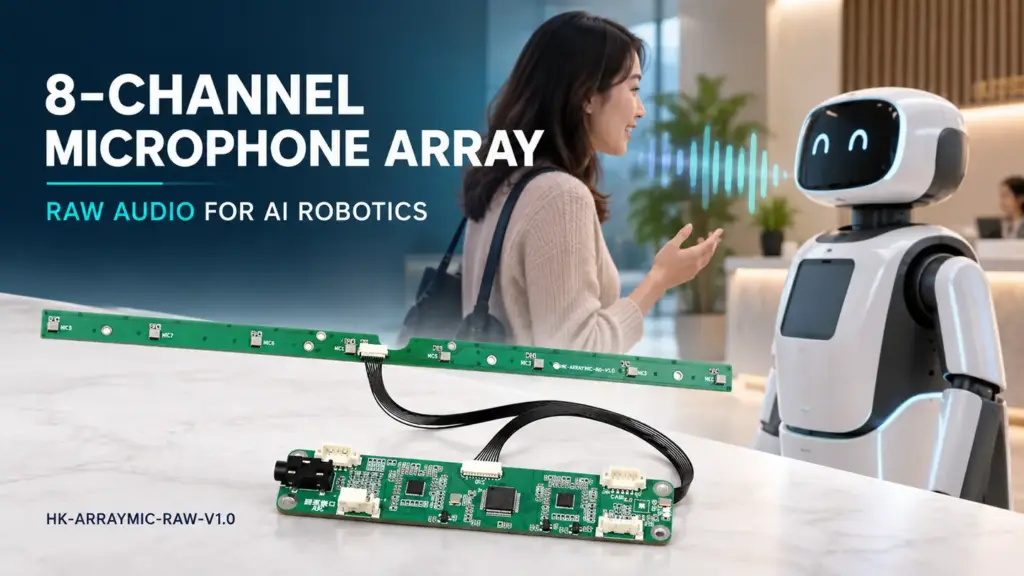
HK-ARRAYMIC-RAW-V1.0: Advanced 8-Channel Microphone Array Module for AI & Intelligent Robotics
Explore how raw multichannel audio from the HK-ARRAYMIC-RAW-V1.0 can support host-side audio processing in AI and robotics projects.