

Microphone arrays for robotics: applications and integration
Microphone arrays for robotics: applications and integration
Microphone arrays combine signals from microphones at known positions to capture useful spatial information about sound. With suitable signal processing, they can emphasize speech from a chosen direction and reduce interference arriving from elsewhere. In robotics, this gives the speech system a way to focus on the person interacting with the machine.
A robot microphone array must work inside a complete product: a housing with acoustic openings, moving mechanisms, cooling fans and a loudspeaker. Selecting one requires attention to the intended conversation area, the audio interface and the conditions under which people will actually speak.
For a reception robot, that may mean understanding one visitor standing in front of its screen. For a mobile assistant, it may also mean detecting speech while the robot turns or its motors are running. These applications need different coverage and validation methods.
How a robot microphone array processes speech
Sound reaches microphones at slightly different times because each microphone occupies a different position. Array processing uses these relationships to distinguish arrival directions and combine the signals.
Beamforming applies delays or filters and weights to produce a directional response. Its effectiveness depends on microphone spacing, array geometry and sound frequency. A pickup angle therefore needs to be interpreted alongside a frequency-dependent polar response.
Several other functions may be part of the audio front end:
| Function | Role in a robot voice system | What to verify |
|---|---|---|
| Beamforming | Emphasizes sound from a selected region | Coverage across the intended user positions |
| Acoustic echo cancellation (AEC) | Reduces the robot’s own loudspeaker playback in the microphone signal | Playback reference routing and speech capture during playback |
| Noise suppression | Reduces unwanted background components | Speech quality with fans, motors and surrounding activity |
| Automatic gain control (AGC) | Adjusts the output level as input speech level changes | Quiet speech, loud speech and clipping behavior |
| Direction-of-arrival estimation (DoA) | Estimates where a sound is coming from | Whether directional data is available to the robot controller |
Directional pickup and DoA are separate capabilities. A module can deliver directional audio without exposing a speaker angle. A robot that must turn toward a person needs a documented localisation output or a separate perception method.
AEC also has a specific integration requirement: it needs a reference representing the loudspeaker playback. The canceller models the loudspeaker-to-microphone acoustic path and reduces the corresponding echo. .
Match directional coverage to the interaction
Start by defining where the user should stand and whether the robot is stationary during the conversation.
A linear array can be practical behind a display bezel or along a narrow panel. A circular arrangement may suit designs that need coverage around the robot. Neither geometry establishes the complete coverage pattern by itself; processing and enclosure design remain part of the result.
Array aperture, the physical span of the microphones, also matters. Adding microphones within a small footprint does not produce the same directional response as increasing the aperture. Channel synchronisation and microphone matching affect how accurately signals combine.
Specify the conversation area before choosing microphone count. A controlled interaction zone may suit a front-facing reception task. A robot approached from several directions needs a coverage design that explicitly addresses those positions.
Applications of microphone arrays in robotics
Reception and customer-service robots
Consider a visitor asking a reception robot for directions while nearby people are talking. The design task is to capture that visitor’s request without making them lean toward the housing or repeat it at an unnatural volume.
Evaluate a directional array against the actual standing area, including the side positions people use when a queue forms. Coordinate the screen prompts with this area so users can see where to interact. Test requests containing names and destinations, since losing one of those words can make an otherwise fluent conversation fail.
Telepresence and remote-assistance robots
A telepresence robot captures local speech while reproducing a remote participant’s voice. Echo control and the ability to preserve local speech during simultaneous talking need particular attention.
Test with the production loudspeaker at its intended volume. Include a local participant interrupting the remote speaker, changes in distance and rooms with reflective surfaces. Assess both what the remote participant hears and whether the local user can interrupt naturally. An AEC feature listing alone does not establish this behavior for the finished robot.
Mobile assistants and humanoid robots
For moving platforms, include speech tests during acceleration, turning, joint movement and cooling-fan changes. A recording made while the robot is idle cannot establish performance during these operating states.
If the robot uses sound direction to orient its head or camera, define how the audio direction relates to the robot’s coordinate system. Validate the estimate during movement and provide a response for uncertain detections. A voice interface can ask the user to repeat a request; motion based on an unreliable direction estimate needs a separate control decision.
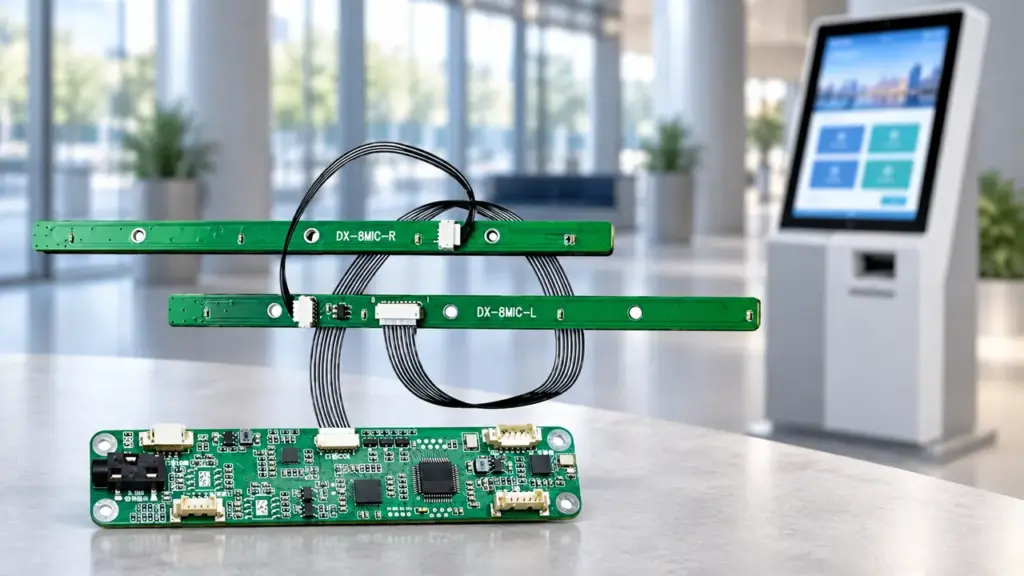
Product example: HAOKAI HK-DXMIC-V1.1-8
The HAOKAI HK-DXMIC-V1.1-8 is an eight-microphone directional module to evaluate for a defined robot interaction area. HAOKAI lists the following specifications and processing functions:
| Item | Published specification |
|---|---|
| Microphones | Eight digital MEMS microphones in a linear array |
| Directionality | Advertised as 60° directional pickup; the specification table describes forward and backward 60° pickup |
| Working distance | Best within 3 meters |
| Audio format | 48 kHz, 16-bit stereo |
| Connection | USB 2.0 with USB Audio Class 1.0 support |
| Processing | Beamforming, AEC, noise suppression, voice enhancement and AGC |
This specification suggests evaluating the module for a reception robot or a screen-based voice interface with defined user positions. Request its polar response to confirm coverage and rear pickup in the proposed installation.
Eight internal microphones do not establish eight raw channels at the host. The page lists stereo audio and does not establish raw multichannel access or DoA output. Confirm these separately if the robot needs custom array processing or sound-guided orientation. Treat the stated distance as an evaluation starting point, with recognition performance verified in the finished system.
Integrate the array with the robot enclosure
Keep microphone openings acoustically accessible and evaluate them with the final grille, mesh and housing installed. Place the assembly with attention to nearby fans, vibrating panels and the loudspeaker.
Robot-audition documentation from HARK identifies housing reflections and structural vibration as causes of degraded localisation and separation. Its microphone installation guidance also addresses mounting and wiring near power and servo connections. Apply those principles alongside the module manufacturer’s mechanical instructions.
On the host side, verify device detection, channel mapping and the audio format delivered to the speech software. Confirm the playback reference path for AEC. Review any additional noise suppression or gain control in the operating system so the team knows which processing stages are active during testing.
Evaluate the complete voice experience
Use the same speech material and recognition configuration when comparing microphone arrays. Record the enclosure version, software settings, user distance and measured background level so results can be reproduced.
The following is a proposed validation matrix for a robot voice interface:
| Test condition | Question to answer |
|---|---|
| Quiet room, user facing the robot | Does the basic interaction work consistently? |
| User at the edge of the intended coverage | Can people speak naturally across the interaction area? |
| Nearby competing talker | Does the robot accept commands from the intended user? |
| Fans and motors operating | Which operating states cause missed or incorrect requests? |
| Robot speaking while the user interrupts | Is the user’s speech preserved during playback? |
| Reflective room with the final housing | Do echo and reverberation disrupt the conversation? |
| Reconnection and restart | Does the audio path recover without manual intervention? |
Measure command completion rate and requests that require repetition. If the system uses a wake word, record missed activations and false activations under defined conditions. For speech transcription, compare word error rate using the same reference transcripts.
Measure response timing from a defined event, such as the end of the user’s utterance, to the robot’s first useful response. Keep audio buffering, recognition and application delays identifiable so the team can diagnose a slow interaction.
Listen to failed recordings as well as reviewing scores. A clipped first syllable, an incorrectly captured name or a pause that causes the robot to answer too early can explain a failure that an average metric hides.
Frequently asked questions
How many microphones does a robot microphone array need?
Choose the count together with aperture, coverage and processing requirements. Microphone count alone cannot establish speech recognition performance. Compare candidate designs in the same enclosure and operating conditions.
Does beamforming provide 360° speaker tracking?
Beamforming creates a directional audio response. Full-circle coverage and speaker tracking require appropriate hardware, algorithms and accessible directional outputs. Verify each capability in the module documentation.
Can a USB microphone array work with a robot’s speech software?
Check the host’s USB audio support, available channels and supported sample formats. Then verify the complete capture and playback path with the intended operating system and speech application.
What makes far-field voice capture reliable?
Reliability depends on the talker’s level and distance, background noise, room reflections, mounting and processing. Set acceptance criteria around successful conversations in the intended environment, supported by recorded test conditions.
Discuss your robot microphone array requirements
For an HK-DXMIC-V1.1-8 evaluation, share the intended user positions, enclosure layout, host platform and loudspeaker arrangement with HAOKAI. Request the current datasheet and integration guidance, then agree on a test plan using representative speech and operating noise before committing the audio design to production.
You May Also Like
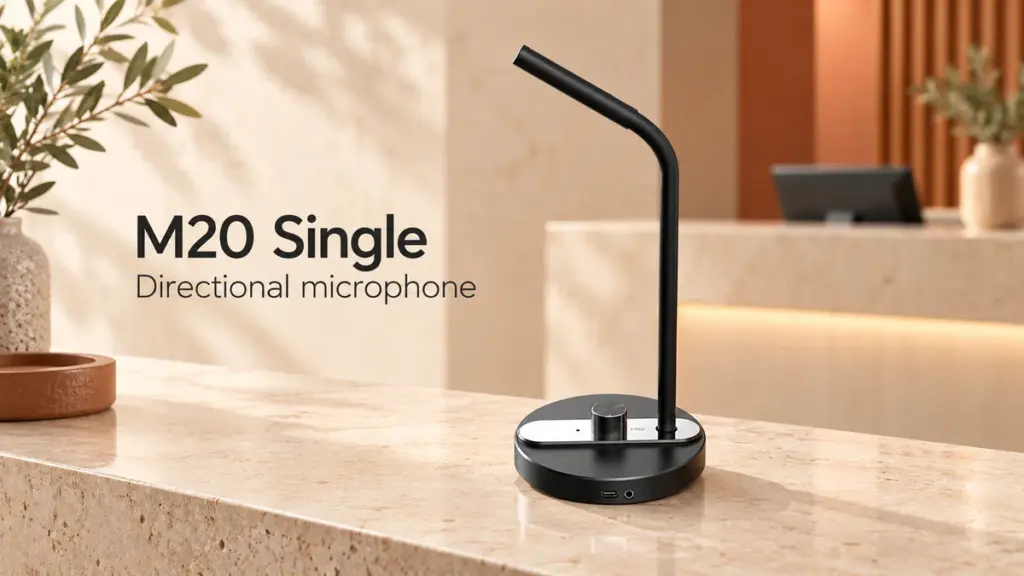
M20 2-Array Directional Microphone: Precision 60° Acoustic Beamforming for High-Noise Counters, Public Services, and AI Voice Capture
Explore the M20 Single's directional pickup approach and its applications in service counters, meetings, and AI voice capture.
Solving Kiosk, Robotics & Intercom Acoustic Challenges: The HK-DXMIC-V1.1-8 Array Microphone Module Application Guide
Review HK-DXMIC-V1.1-8 application scenarios for kiosks, robotics, and intercom systems, including directional pickup and audio processing considerations.
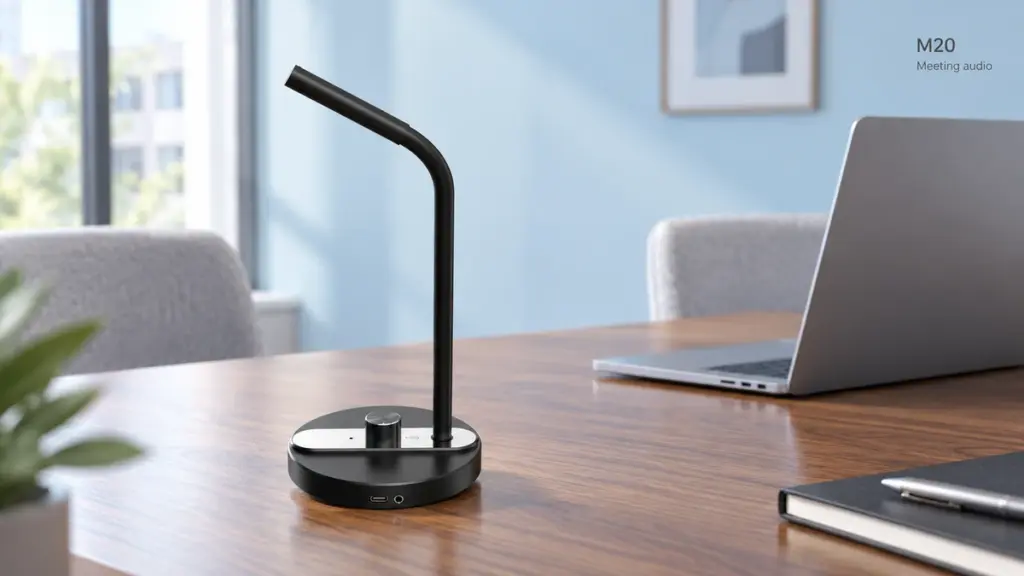
Precision Audio Capture: Exploring the HAOKAI M20 Directional Microphone Array
Read a question-and-answer guide to the M20 microphone array, covering pickup direction, placement, and use in counters and meeting spaces.
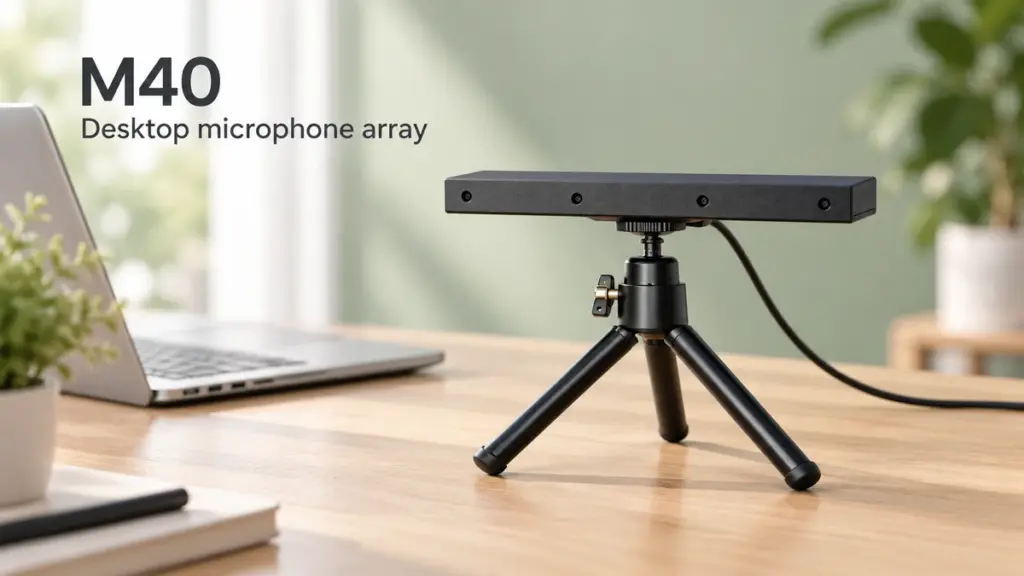
HK-M40 Array Microphone — Elevating Voice Clarity for Smart Interactions
Get an overview of the HK-M40 desktop microphone array and its use in voice interaction, meetings, and smart office applications.