


Precision Audio Capture: Exploring the HAOKAI M20 Directional Microphone Array
In modern acoustic environments—from open-plan offices and hybrid meeting spaces to customer service desks—ambient noise and off-axis audio reverberation remain the primary causes of degraded speech intelligibility. Standard omnidirectional microphones capture sound indiscriminately, often polluting the audio stream with unwanted background noise.
The M20 Directional microphone Array addresses these challenges through spatial filtering and focused pickup architecture. Below is an engineering breakdown of how the M20 solves real-world audio capture challenges.
Q1: How does the M20 microphone Array handle ambient background noise in open or acoustically challenging spaces?
A: The M20 utilizes a specialized 2-microphone array design engineered to form a focused acoustic beam. Instead of capturing audio in a standard 360° or 180° field, it establishes a fixed 60° forward pickup angle.
By restricting the direct audio path strictly to this 60° cone, the hardware creates designated sound shielding zones across the side and rear vectors. Off-axis acoustic reflections, HVAC hum, keyboard clatter, and adjacent conversations occurring outside this zone are physically blocked and suppressed before reaching the digital signal path.
Q2: What is the optimal operational distance and coverage area for the M20 microphone Array ?
A: The M20 is optimized for high-intelligibility near-to-mid-field sound capture, offering a precise effective pickup radius of up to 3 meters (approx. 10 feet) within its 60° forward angle.
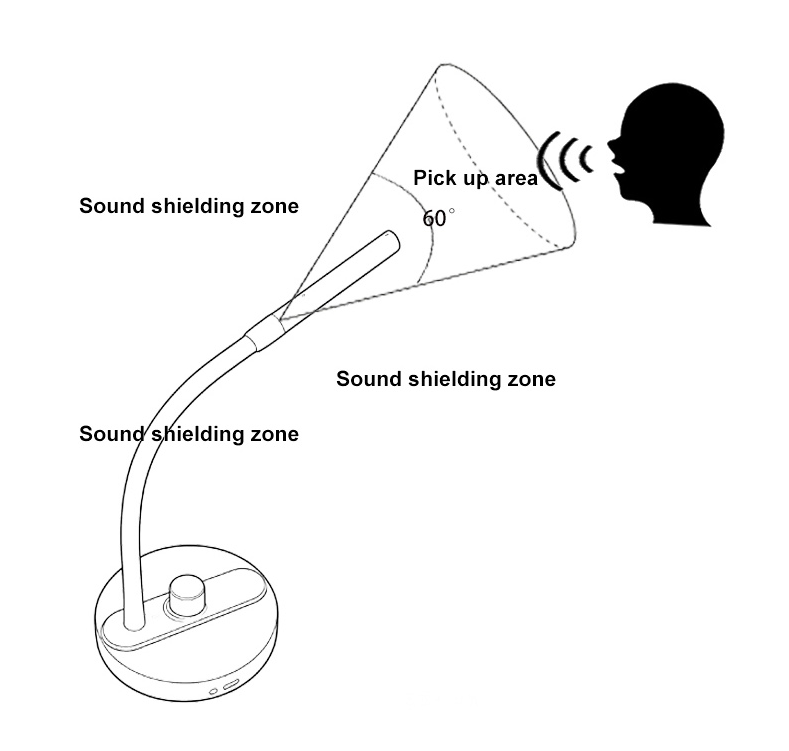
This specific geometry ensures that speech energy within the target zone remains clear, direct, and well-balanced without requiring the user to lean directly over the microphone base.
Q3: In which key commercial applications does the M20 microphone Array provide the highest ROI?
A: The M20 excels in scenarios requiring strict acoustic isolation between adjacent zones:
Executive Workstations & Huddle Spaces: Delivers crisp voice transmission for video conferencing without picking up ambient chatter from surrounding office areas.
Service Counters & Banking Windows: Isolates speaker audio between client and staff, protecting transaction privacy while preventing adjacent counter spillover.
Focus Rooms & Hybrid Classrooms: Ensures remote participants hear only the speaker positioned at the table, eliminating distracting room reflections and HVAC rumble.
Q4: How does spatial acoustic isolation improve downstream Audio DSP performance?
A: Digital Signal Processors (DSPs) and AI-driven noise suppression algorithms perform significantly better when supplied with clean acoustic data. When a microphone relies purely on post-processing software to strip out heavy 360° noise, signal degradation and audible phase artifacts often occur.
The M20 solves this at the physical acoustic layer: by isolating the primary sound source hardware-wise via its directional 2-mic array, the signal arriving at the DSP has a far higher Signal-to-Noise Ratio (SNR). This reduces processor load and ensures natural, artifact-free voice output.
Technical Specifications Summary
| Parameter | Specification |
| Microphone Architecture | 2-Array Directional Microphone |
| Pickup Pattern | Directional 60° Fixed Forward Angle |
| Effective Capture Distance | Within 3 Meters |
| Primary Deployment | Desktop / Surface-Mounted Boundary Capture |
Elevate Your Spatial Audio Deployment
For complete product documentation, technical whitepapers, or enterprise procurement inquiries, visit the official product page:
👉 Discover M20 Directional Microphone Array
You May Also Like
HK-M40 Array Microphone — Elevating Voice Clarity for Smart Interactions
HAOKAI Unveils HK-M40 Array Microphone: Empowering AI Voice & Smart Office Ecosystems with Far-Field Audio Capture Leading acoustic solutions provider HAOKAI has officially...