

8 MEMS microphone array: applications and design considerations
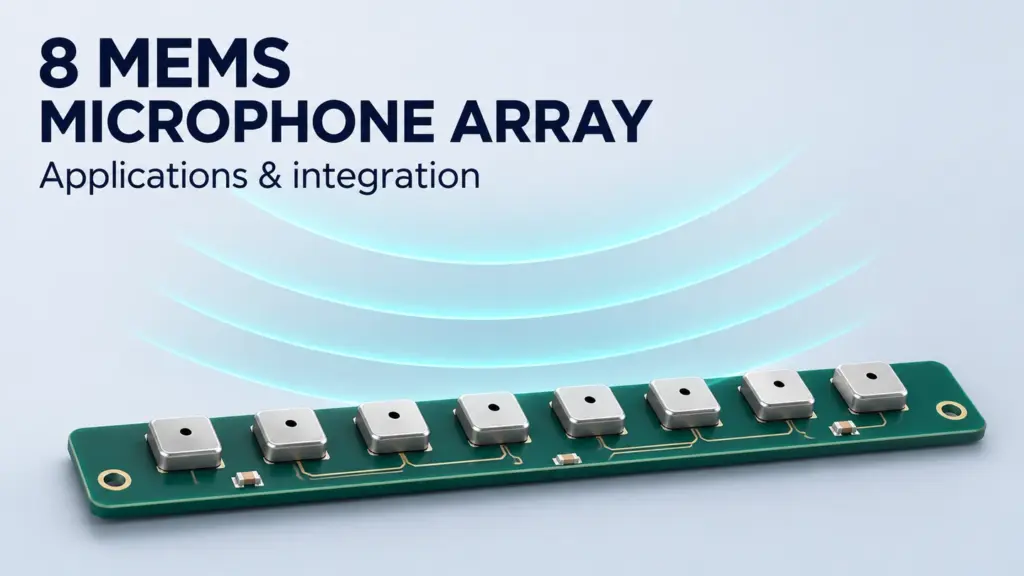
An 8 MEMS microphone array combines eight microelectromechanical microphones in a defined layout. When their signals are captured with consistent timing, a processor can use differences between channels for tasks such as beamforming and sound source localization. The available functions depend on the array geometry, acquisition hardware, and software.
For engineers building a voice interface, the first decision is how audio will reach the application: as separate microphone signals for custom processing, or as speech already processed by an onboard DSP. That choice affects development work, host requirements, and how the system should be tested.
How does an 8 MEMS microphone array work?
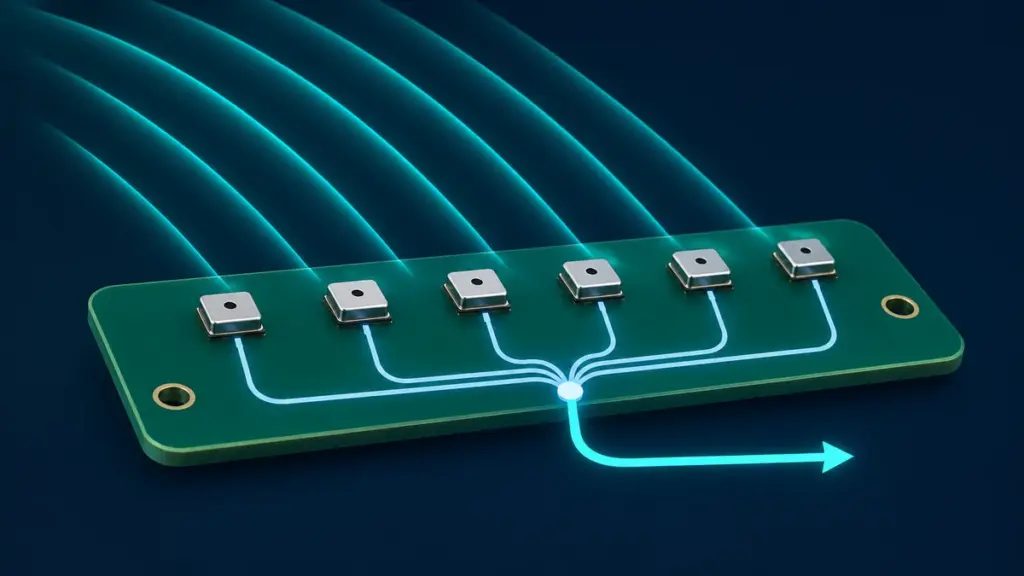
Sound reaches microphones at different positions at slightly different times. A delay-and-sum beamformer compensates for these arrival differences for a chosen direction, then combines the signals. Adaptive beamformers adjust their processing to the acoustic conditions.
Microphone count alone does not define the pickup pattern. The layout, spacing, and processing determine how an array responds to sound from different directions.
When reviewing a module, check the physical microphone count separately from the output channel count. An audio interface can include reference or spare channels, while a processed array can combine several microphone inputs into fewer output channels.
Where can an 8 MEMS microphone array be used?
Service robots and interactive terminals
A robot or reception terminal may need to capture a person speaking near a display while fans, motors, or nearby conversations create interference. An array provides inputs for directional processing; a localization algorithm can also estimate the sound source direction when the hardware and geometry support it.
Evaluate speech capture with the robot moving and stationary. For a kiosk, repeat the test with people speaking from the expected user positions. If the device plays spoken responses, include playback in the test and check whether users can interrupt it successfully.
Video conferencing and interactive displays
Conferencing systems must handle changing speaker positions and audio from their own loudspeakers. Relevant processing can include acoustic echo cancellation (AEC), noise suppression, and automatic gain control (AGC). Each function needs validation in the finished device.
Test quiet speakers and overlapping conversation, including occasions when a remote participant speaks at the same time as someone in the room. Record the transmitted audio as well as listening locally, since the remote listener’s experience is the useful outcome.
Voice control in commercial and industrial equipment
For a voice-controlled workstation or machine interface, evaluate whether the intended commands remain recognizable during normal equipment operation. Test representative operating cycles, including intermittent sounds that a quiet-room demonstration would miss.
A voice acquisition module still needs its own environmental qualification. Temperature limits, vibration tolerance, and protection from dust or moisture must be checked against the requirements of the installation.
Acoustic research and algorithm development
Researchers developing beamforming or time-difference-of-arrival algorithms need access to the relevant microphone channels. A raw multichannel module lets a team apply its own processing and compare results using the same recordings.
Before collecting a dataset, verify channel order, microphone coordinates, sampling configuration, and any processing that remains active. Preserve this information with the recordings so another researcher can reproduce the experiment.
Raw multichannel audio or onboard DSP?
| Integration question | Raw multichannel audio | Onboard DSP processing |
|---|---|---|
| Who implements the voice processing? | Your host software or research pipeline. | The module handles its supported functions. |
| What should you verify? | Channel access, timing consistency, gain behavior, and host processing capacity. | Enabled algorithms, output format, configuration access, and latency. |
| When is it worth evaluating? | When developing algorithms or retaining control over individual microphone signals. | When the application needs processed speech and the supplied functions match its requirements. |
Confirm the exact firmware configuration before choosing either route. A module with eight microphones does not necessarily expose eight independent raw channels, and an AEC reference connection does not by itself mean echo cancellation is running.
What should you check before integrating an array?
- Define the listening area. Document where users will stand or sit, their expected speaking distance, and the positions of competing sound sources.
- Review the microphone layout. Obtain microphone coordinates and spacing. For localization work, check whether the geometry can resolve the directions your application needs.
- Confirm the audio path. Check the actual output channel map, sample rate, bit depth, interface, and firmware. Verify capture on the intended host operating system.
- Plan for speaker playback. If AEC is required, establish how the playback reference reaches the processor and test simultaneous speech and playback.
- Test the installed assembly. Include the enclosure, mounting position, ventilation system, and production audio settings. Compare recordings with your current microphone solution under the same conditions.
Set acceptance criteria around the task. These might include command recognition success, transcription errors, or speech intelligibility at specified user positions. Record the room conditions and playback level alongside the results. A nominal pickup distance alone cannot establish whether the complete system meets those criteria.
How should teams plan for future voice applications?
For products expected to gain new voice features, evaluate the update path during hardware selection. Ask whether firmware can be updated, whether processing settings are accessible, and whether diagnostic audio can be captured when an issue occurs.
Teams considering local AI processing should benchmark the complete audio pipeline on their intended host. Measure processing latency and resource use alongside recognition performance. If source direction is part of a planned feature, confirm that the hardware exposes the signals or direction data needed to develop it.
These are design choices to assess against a product roadmap. Adding microphones does not automatically provide an upgrade path for every future algorithm.
Explore HAOKAI array integration options
We offer array modules for different processing approaches. HK-ARRAYMIC-RAW-V1.0 provides eight-channel raw audio for host-side development. HK-ARRAYMIC-V3.2-8 combines an eight-microphone linear array with AEC, noise suppression, and AGC. HK-M80DC combines an eight-microphone array with a camera for audiovisual terminals.
Compare the processing approach and mechanical format with your device requirements, then review the model’s technical specifications before planning an evaluation.
FAQs
Is an 8 MEMS microphone array better than a 4-microphone array?
Performance depends on geometry, microphone characteristics, processing, and the acoustic environment. Compare both arrays using the same speech positions and noise conditions. Eight microphones alone do not establish a performance advantage for a particular device.
Does an 8 MEMS microphone array provide 360-degree pickup?
Coverage depends on the array layout, processing, and installation. Verify the model’s directional response and test the intended listening area rather than inferring coverage from the microphone count.
Can an 8 MEMS microphone array locate a speaker?
It can support localization when the system provides suitable channel timing, known microphone positions, and a localization algorithm. Confirm the supported directions and accuracy under the intended operating conditions.
Does every array include noise suppression and echo cancellation?
No. Some modules output raw audio for host-side processing. Others include DSP functions. Check which algorithms are enabled and what signals, including any playback reference, they require.
You May Also Like
Microphone array vs. single microphone: What is the difference?
Compare microphone arrays and single microphones for embedded voice systems, including directional pickup, processing, host audio, and HAOKAI module selection.
MEMS mic applications for robots, kiosks, and voice R&D
Compare three microphone array modules for service robots, voice kiosks, and acoustic research. See what output each application needs and...
Audio array mic for voice kiosks: How to test speech capture
Test a microphone array for voice kiosks using realistic customer speech, competing talkers, loudspeaker playback, and recognition results in the...
Mic array meaning: What is a microphone array and how does it work?
Understand what a mic array means, how it works, and how to compare microphone count, directional pickup, audio processing, and...