

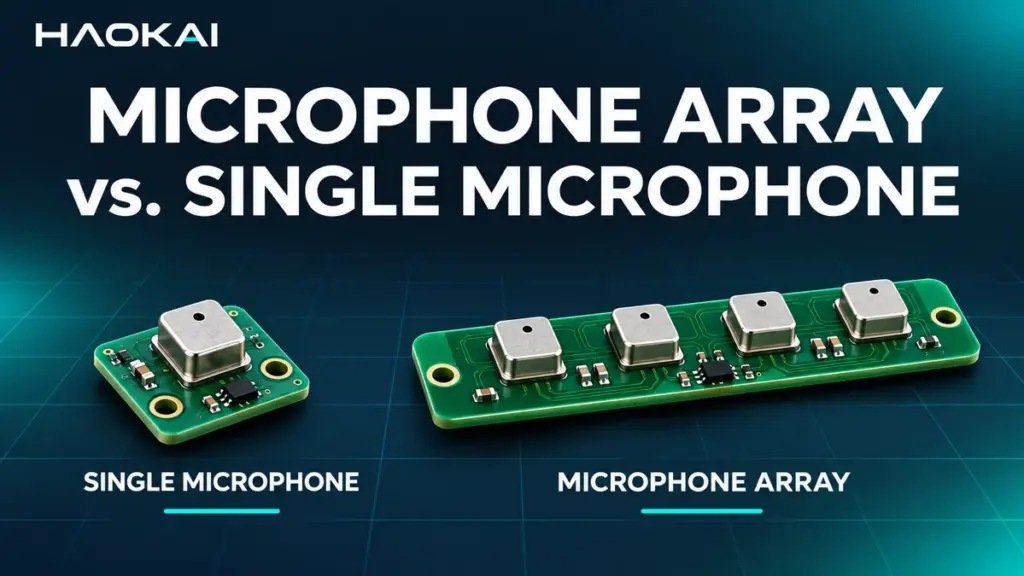
Microphone array vs. single microphone: What is the difference?
The main difference between a microphone array and a single microphone is how they capture spatial information. A single microphone captures sound at one location. A microphone array uses two or more microphones at known positions, allowing suitable processing to use the differences between their signals for directional pickup or sound-source localization.
For product developers, this affects more than the number of microphones on a board. It changes how a device listens, what audio reaches the host, and how much processing the system needs.
A single microphone can be a practical choice when a person speaks close to the device. An array becomes useful when the application needs hands-free voice capture, a defined listening zone, or spatial information for further processing. The right choice depends on the acoustic task and the finished device.
Microphone array vs. single microphone at a glance
| Aspect | Single microphone | Microphone array |
|---|---|---|
| Capture arrangement | One microphone element | Two or more microphones in a defined arrangement |
| Spatial information | One capture position | Multiple capture positions for joint processing |
| Pickup pattern | Can be omnidirectional or directional | Depends on the elements, geometry, and processing |
| Beamforming | Does not provide spatial beamforming across multiple microphone positions | Can support beamforming with suitable processing |
| Noise control | Can use directional response and single-channel processing | Can combine spatial filtering with other noise processing |
| Host audio | Commonly one microphone channel | May provide processed audio, individual microphone channels, or both |
| Integration work | Usually fewer capture components | May require channel matching, synchronization, and array-aware acoustic design |
| Typical evaluation focus | Placement, sensitivity, noise, and distortion | The same factors, plus coverage, geometry, channel behavior, and processing |
A directional single microphone and a directional microphone array can both favor sound from a particular direction. Their acoustic structures and processing methods differ.
How does a microphone array work?
Sound reaches each microphone at a slightly different time because the microphones occupy different positions. Array processing uses the relationships between these signals.
A beamformer applies delays, filters, or weights to combine the microphone signals into a directional response. This can emphasize sound from a desired direction while reducing sound arriving from other directions.
Beamforming and sound-source localization perform different tasks. Beamforming shapes the listening response. Localization estimates where a sound originates. A module may support one function without providing the other.
The delivered audio also matters. A four-microphone module may send a processed speech stream to the host without exposing four independent microphone channels. Microphone count and USB output channel count should be checked separately.
Is a microphone array always better?
A microphone array is useful when its spatial capabilities solve an application requirement. It does not automatically provide better recordings in every situation.
Close speech can favor a single microphone
When the microphone can remain close to the speaker, a single-microphone design may provide adequate speech capture with fewer integration demands. Headsets and close-speaking terminals are examples worth evaluating.
A comparison should reflect the intended placement. A distant array and a microphone positioned near the speaker face very different acoustic conditions.
Hands-free interaction can benefit from an array
A kiosk or conferencing device often needs to capture speech without asking users to hold or wear a microphone. An array with suitable processing can help control the listening region and reduce interference from other directions.
Performance still depends on room reflections, competing voices, microphone placement, and the processing implementation. Interference arriving from the same direction as the desired speaker can remain difficult to separate.
More microphones do not guarantee clearer speech
Adding microphones changes the information available to the processor. The result depends on how well the system uses that information.
Poor channel matching, unsuitable spacing, or enclosure obstructions can limit the benefit. Evaluate speech intelligibility in the assembled device before choosing a module by microphone count alone.
Omnidirectional or directional microphone array?
Array architecture and pickup coverage describe different aspects of a product.
An omnidirectional microphone array is intended to capture voices around the device. This can suit interactions where people approach from different sides.
A directional microphone array focuses on a defined listening region. This can suit a terminal where the user stands in front of a display or a recording device serving known speaking positions.
A 360° pickup description does not establish equal sensitivity at every position or automatic speaker separation. Likewise, a directional angle describes a nominal pickup region, not a boundary beyond which all sound disappears. Frequency and measurement conditions affect the actual response.
For selection, begin with where people will speak and which surrounding sounds the device should reject.
HAOKAI microphone modules for different listening requirements
We offer microphone array modules for broad coverage, focused pickup, and two-position voice interaction. These examples illustrate how the listening task guides module selection.
Technical specifications
| Model | Microphone arrangement | Pickup coverage | Processing and audio connection | Pickup distance |
|---|---|---|---|---|
| HK-JZMIC-V1.0 | Two analog microphones | 360° omnidirectional pickup | Voice enhancement, noise suppression, AGC; USB Audio Class 1.0; 48 kHz / 16-bit | Best within 5 m; validate in the intended environment |
| HK-DXMIC-V1.1-4 | Four digital MEMS microphones in a linear arrangement | Nominal 60° directional pickup | Beamforming, AEC, voice enhancement, noise suppression, AGC; USB Audio Class 1.0; 48 kHz / 16-bit | Optimal within 3 m; subject to placement and acoustic conditions |
| HK-SDXMIC-V1.1 | Four digital microphones | Dual nominal 60° directional pickup zones | Beamforming, voice enhancement, noise suppression, AGC; left/right channel separation; USB Audio Class 1.0 | Best within 3 m; validate both speaking positions |
Broad coverage around a device
HK-JZMIC-V1.0 provides a compact USB integration option for voice capture from multiple directions. It is an option to evaluate for conferencing terminals and interactive devices where users do not remain in one fixed speaking position.
Focused capture in a defined user zone
HK-DXMIC-V1.1-4 combines a linear microphone array with directional beamforming and onboard voice processing. It is an option to evaluate for display-mounted devices or terminals with a defined interaction area.
Its AEC function addresses loudspeaker audio returning to the microphones. Echo performance needs testing with the final playback path and speaker arrangement.
Two distinct speaking positions
HK-SDXMIC-V1.1 supports dual-directional independent pickup and left/right channel separation. It is designed for two-way interaction products, including translation terminals and service-counter devices.
Separate pickup zones should be tested with overlapping speech and realistic background noise. Channel separation does not imply perfect isolation between speakers.
What should engineers check before choosing?
Define coverage and distance
Document where users stand or sit, their expected speaking distance, and whether they move during interaction. Include the sounds outside the intended user zone.
This determines whether broad coverage, a fixed directional response, or another microphone arrangement is worth evaluating.
Confirm raw or processed output
Researchers developing beamforming algorithms may need synchronized, individual microphone channels. Product teams integrating a speech interface may prefer processed audio from onboard DSP.
Confirm the actual channel map, supported audio formats, and enabled processing. A USB connection alone does not establish access to raw multichannel recordings.
Separate beamforming, noise suppression, AEC, and AGC
These functions address different problems:
- Beamforming controls spatial sensitivity.
- Noise suppression reduces unwanted background sound.
- Acoustic echo cancellation reduces device playback captured by the microphones.
- Automatic gain control adjusts signal level.
Test the finished enclosure
Evaluate candidate designs using the same speech material, playback levels, and representative noise conditions.
Check intelligibility across the full user zone, competing speech from outside that zone, and speech captured during loudspeaker playback. For speech-recognition applications, compare recognition results using the intended recognition engine.
Record the microphone placement and processing settings with each test. This makes comparisons repeatable and helps identify whether a problem comes from the module, the enclosure, or the surrounding acoustics.
Choosing a microphone architecture for your device
A single microphone is a reasonable starting point when close placement satisfies the capture requirement. A microphone array is worth evaluating when the device needs spatial processing, broader hands-free coverage, or controlled listening zones.
For HAOKAI module selection, define the required coverage and audio output first. Then compare the relevant module in the intended enclosure, at realistic speaking distances, with the actual host and playback system.
Explore our microphone array guide for more detail on array geometry, onboard processing, and raw multichannel capture.
FAQs
What is the main difference between a microphone array and a microphone?
A single microphone captures sound at one location. A microphone array uses multiple microphones at known positions, providing signals that suitable processing can use for beamforming or sound-source localization.
Can a single microphone be directional?
Yes. A single microphone can have a directional pickup pattern. Directionality alone does not establish that a device contains a microphone array.
Does a microphone array always reduce background noise?
No. Noise reduction depends on the array design, processing, and acoustic environment. Microphone count alone does not establish how much noise the system will suppress.
Does a four-microphone array provide four recording channels?
Not necessarily. Some modules combine the microphone signals into processed audio before sending it to the host. Confirm whether the module exposes individual raw channels, processed output, or both.
Can a microphone array replace acoustic echo cancellation?
Beamforming and AEC perform different functions. Beamforming shapes directional sensitivity, while AEC targets loudspeaker playback returning to the microphone input. A device that plays audio while listening should have its echo-control requirements evaluated separately.
Which HAOKAI array should I evaluate first?
Evaluate HK-JZMIC-V1.0 for broad pickup around a device, HK-DXMIC-V1.1-4 for a defined directional listening zone, and HK-SDXMIC-V1.1 for two distinct speaking positions. Final suitability depends on the enclosure, host requirements, and acoustic testing.
You May Also Like
8 MEMS microphone array: applications and design considerations
Explore how an eight-element MEMS microphone array can support robotics, conferencing, voice control, and acoustic research, with practical guidance on...
MEMS mic applications for robots, kiosks, and voice R&D
Compare three microphone array modules for service robots, voice kiosks, and acoustic research. See what output each application needs and...

Audio array mic for voice kiosks: How to test speech capture
Test a microphone array for voice kiosks using realistic customer speech, competing talkers, loudspeaker playback, and recognition results in the...
Mic array meaning: What is a microphone array and how does it work?
Understand what a mic array means, how it works, and how to compare microphone count, directional pickup, audio processing, and...