

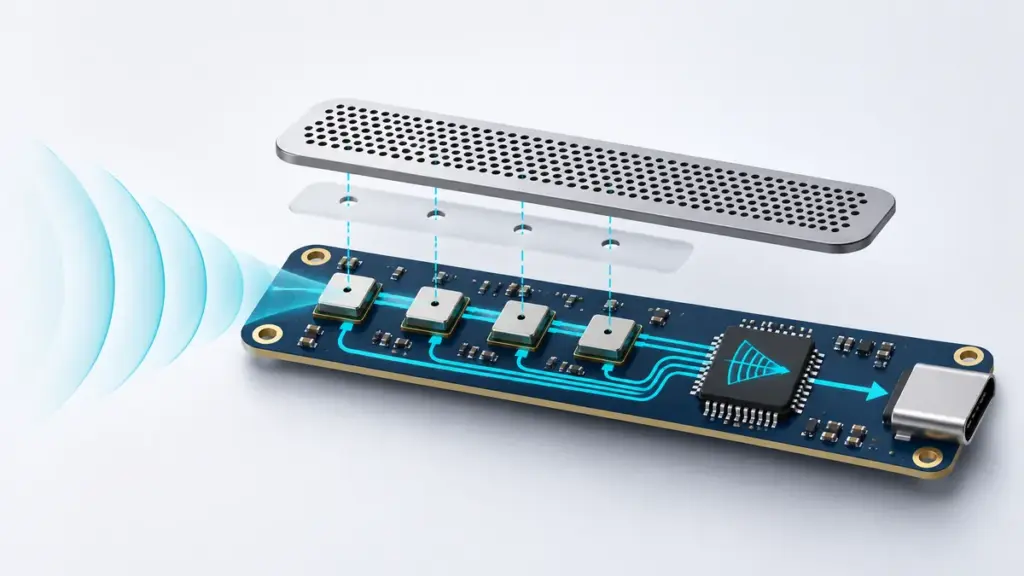
Microphone components: what each part does
A microphone converts sound pressure into an electrical signal. Each microphone component handles a stage in that process: an acoustic opening admits sound, a transducer converts pressure changes, circuitry prepares the signal, and an interface passes audio to the next device.
A directional array module adds several microphones arranged in a defined geometry. Its electronics may digitize and process those signals before sending audio to a host. The exact components depend on the transducer type and on where conversion and processing happen.
Main components of a microphone
| Component | What it does | What to check |
|---|---|---|
| Grille or acoustic port | Lets sound reach the sensing element and helps protect it from contact and debris. | Confirm that the enclosure opening, grille, or fabric does not obstruct the intended acoustic path. |
| Capsule or transducer | Converts sound pressure into an electrical change. Its construction depends on the microphone type. | Check the transducer type and its documented acoustic characteristics. |
| Preamplifier or analog front end | Buffers and conditions a low-level microphone signal before later processing or conversion. | Check gain, noise, power needs, and whether the stage is integrated or external. |
| Analog-to-digital converter and clock | The converter turns an analog waveform into samples; the clock provides sampling timing. | Confirm sample format, channel timing, and synchronization requirements. |
| DSP and firmware | May apply beamforming, echo cancellation, noise suppression, or automatic gain control. | Verify which functions are present, enabled, configurable, and available in the output you will use. |
| Connector and host interface | Carry audio, control, and sometimes power between the module and the host device. | Confirm connector type, pinout, protocol, audio format, and host compatibility. |
| Housing and mounting | Hold the components in position and define how sound reaches the microphones. | Evaluate the complete assembly in its intended enclosure and mounting position. |
Standalone analog microphones, digital MEMS microphones, and USB array modules place these stages in different components.
How the transducer changes by microphone type
The transducer is the part that responds directly to sound pressure. In a conventional condenser microphone, a thin diaphragm moves relative to a fixed backplate. Their changing spacing alters capacitance and produces an electrical signal. A moving-coil dynamic microphone instead moves a coil attached to a diaphragm through a magnetic field.
Those examples do not cover every microphone architecture. MEMS microphones use miniature sensing elements, and digital versions include a digital signal path. When reviewing a module, check the specified microphone type and the point where the output becomes digital rather than assuming every design uses a separate capsule and preamplifier.
What a directional microphone array adds
An array uses multiple microphone elements placed at known positions. The layout gives the system spatially separated audio signals. Beamforming algorithms compensate for arrival-time differences across microphones using sensor locations and the direction of the sound. For narrowband signals, a time delay can be implemented as a phase shift.
Directional behavior depends on the array geometry and processing. The number of microphones alone does not describe the pickup pattern or guarantee interference rejection.
Array modules can also differ in the audio they expose to the host. A product may capture with several microphone elements while delivering a processed mono or stereo stream. The host output format therefore should not be inferred from the element count.
For example, HK-DXMIC-V1.1-8 uses eight digital MEMS microphones in a linear array and specifies 60° directional pickup, stereo 48 kHz / 16-bit capture, and a USB 2.0 interface. Compare those details on the HK-DXMIC-V1.1-8 product page with the requirements of the host system. Its configuration is model-specific.
HAOKAI’s directional array microphone modules include different microphone counts, desktop and embedded formats, interfaces, and processing functions. Review each model’s own specification when comparing them.
How the signal moves through an array module
A typical signal path is:
Sound pressure → microphone elements → signal conditioning and conversion → optional DSP → host interface
Some products combine stages inside a microphone package or on one module. Others rely on the host for part of the processing. For an array, the position of each element and the timing relationship between channels also matter. Ask whether the host receives raw channels, processed audio, or both, and whether the required channel mapping and synchronization are available.
Functions such as beamforming, acoustic echo cancellation (AEC), noise suppression (NS), and automatic gain control (AGC) are processing features. They are not physical microphone components, and they are not included in every microphone or array. AEC also depends on how the microphone system relates to the device’s playback path. Confirm the actual signal routing and operating modes for the model under evaluation.
A component checklist for device integration
Before choosing a directional array module, write down the requirements for the finished device:
- Acoustic coverage: Specify the talker position, distance, direction, and expected background sound. Treat a stated pickup angle or distance as a product condition to verify in the intended setup.
- Microphone and channel architecture: Record the number and placement of microphone elements, then separately specify the host’s required raw or processed audio channels.
- Signal format and interface: Match the module’s connector, protocol, sample rate, bit depth, power, and host support to the device.
- Processing behavior: Identify which features must run on the module and which can run on the host. Check their configuration, firmware dependencies, and interaction with loudspeaker playback.
- Mechanical integration: Review microphone-port locations, board dimensions, mounting points, vibration paths, and the effect of the finished enclosure on the acoustic opening.
- Validation: Test speech, playback, background noise, and more than one talker when the application requires it. Use the intended enclosure and repeatable speaker positions.
This sequence separates the microphone element from the rest of the capture system. It also gives engineering and purchasing teams a shared checklist for comparing module specifications.
FAQs
What are the main components of a microphone?
Common microphone systems include an acoustic opening, a transducer, signal-conditioning electronics, an output connection, and a housing. A digital or array module may also include conversion, timing, and signal processing. The exact construction depends on the microphone type.
What does a microphone capsule do?
The capsule contains the sensing element that responds to sound pressure. Depending on the design, it may include a diaphragm and backplate, a diaphragm and moving coil, or another transducer structure.
Does an eight-microphone array provide eight audio output channels?
Not necessarily. Eight describes the number of microphone elements. The host may receive raw channels, a processed mono stream, stereo audio, or another output. Confirm the model’s actual interface and channel map.
Is beamforming a microphone component?
Beamforming is a signal-processing method that combines signals from array microphones to create directional sensitivity. It may run in the module or elsewhere in the device, depending on the system design.
Which components matter most when selecting a microphone array?
Start with the acoustic layout and required host output. Then confirm the signal interface, processing behavior, enclosure fit, and performance in the intended use conditions. A microphone count by itself is not enough to determine system suitability.
You May Also Like
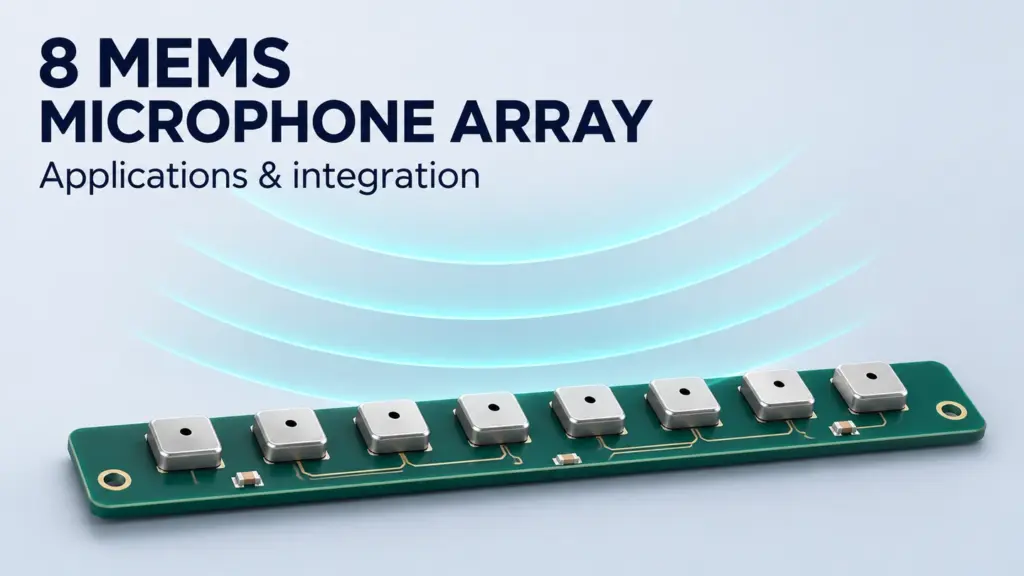
8 MEMS microphone array: applications and design considerations
Explore how an eight-element MEMS microphone array can support robotics, conferencing, voice control, and acoustic research, with practical guidance on...
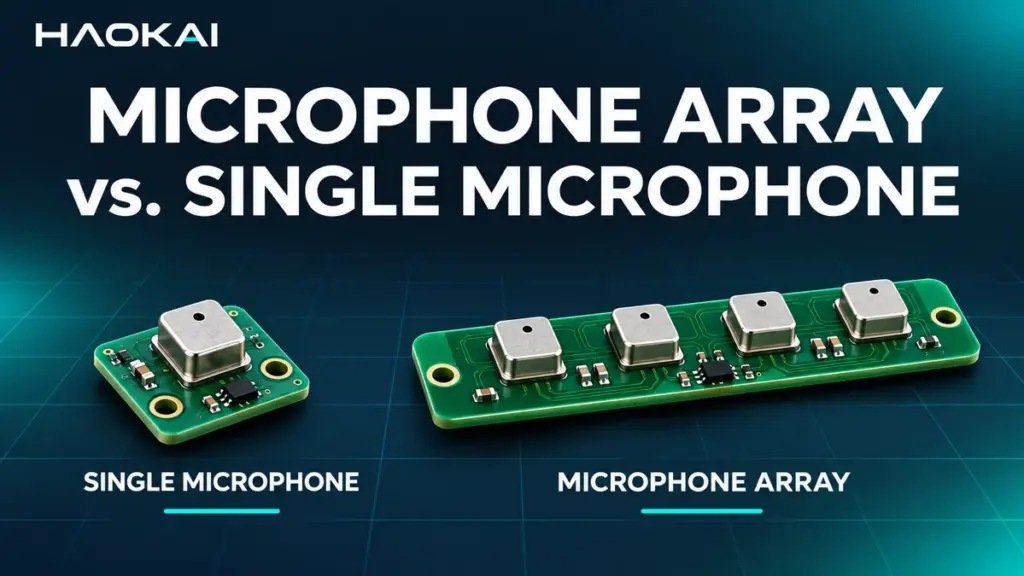
Microphone array vs. single microphone: What is the difference?
Compare microphone arrays and single microphones for embedded voice systems, including directional pickup, processing, host audio, and HAOKAI module selection.
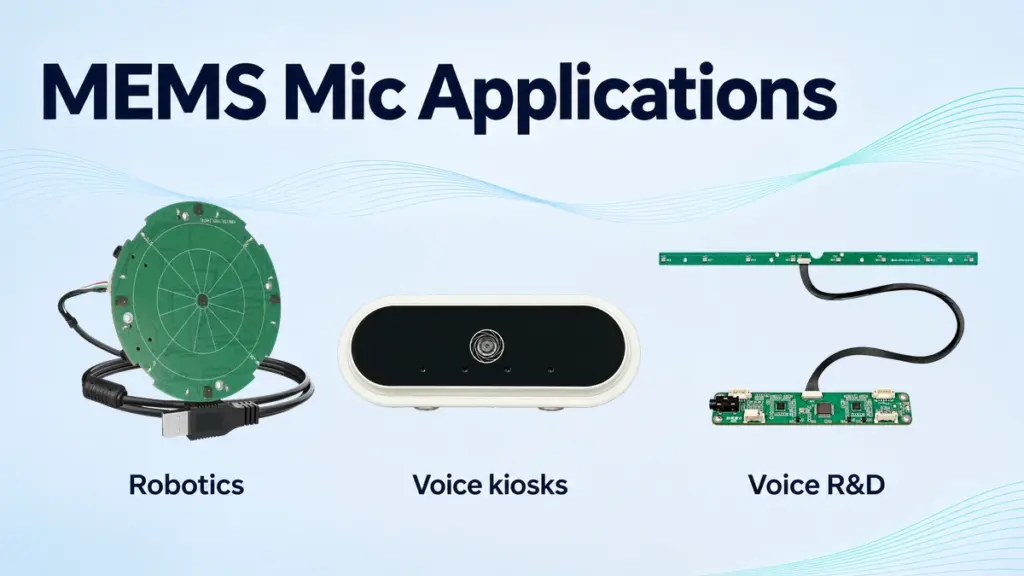
MEMS mic applications for robots, kiosks, and voice R&D
Compare three microphone array modules for service robots, voice kiosks, and acoustic research. See what output each application needs and...

Audio array mic for voice kiosks: How to test speech capture
Test a microphone array for voice kiosks using realistic customer speech, competing talkers, loudspeaker playback, and recognition results in the...