

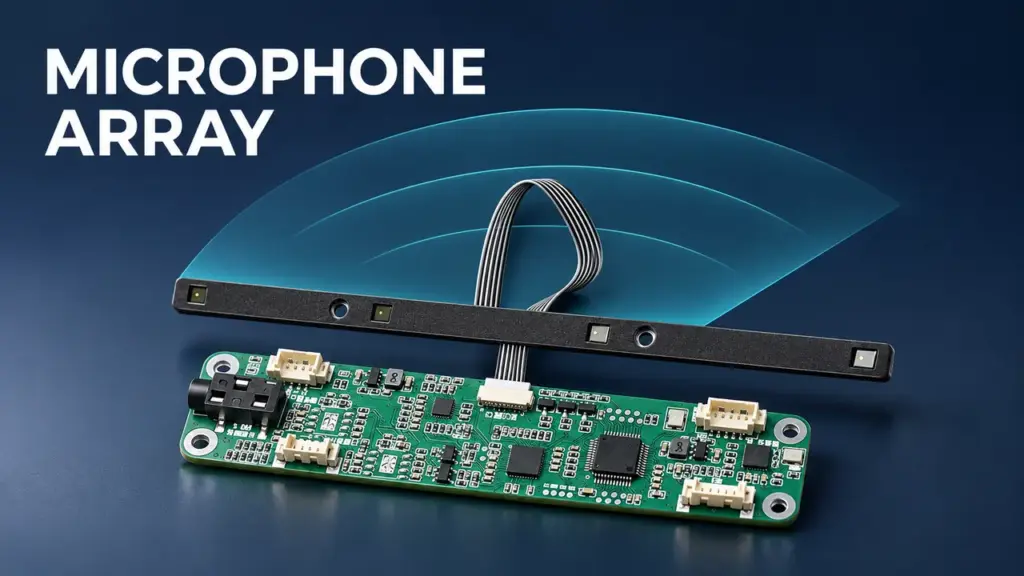
Microphone array: how it works and how to choose a module
A microphone array is a group of microphones arranged at known positions and used together to capture sound. Differences in when sound reaches each microphone provide spatial information that suitable processing can use for directional pickup or sound-source localization. Beamforming combines the microphone signals to emphasize a desired direction and reduce interference from other directions.
For a product engineer, choosing a microphone array starts with the listening task: where users stand, whether the device plays audio, and whether the host needs raw microphone channels or processed speech. These decisions determine which module is worth evaluating.
This guide focuses on embedded voice systems, including industrial terminals, service robots, conferencing devices, and research platforms.
How does a microphone array work?
A sound wave reaches microphones at slightly different times because each microphone occupies a different position. A beamformer applies delays, filters, or frequency-dependent weights before combining those signals. With suitable alignment, the desired speech adds coherently; interference arriving from other directions receives a different response.
Delay-and-sum beamforming uses a predefined steering direction. Adaptive methods adjust their response to the measured acoustic environment. Their performance depends on the source model and steering accuracy, as well as available processing resources.
Sound-source localization performs a related task: estimating where sound originates. A module can provide a direction estimate without exposing raw channels, and a raw array can supply microphone signals without running a localization algorithm. Check the actual outputs required by your application.
Microphone array vs. a single microphone
A single microphone measures sound at one position and may have an omnidirectional or directional response. An array provides multiple spatial measurements for joint processing. This can support electronic steering or source-direction estimation, but microphone count alone does not establish speech quality.
Microphone matching also matters. Differences in sensitivity and channel response affect how accurately the signals combine.
Choose coverage around the user interaction
Define the intended listening region before comparing boards.
| Application requirement | Architecture to evaluate | Main question to resolve |
|---|---|---|
| A user speaks from a defined position in front of a kiosk | Directional array with integrated processing | Does speech remain intelligible throughout the intended user zone? |
| People approach a robot from different sides | Broad-coverage array; localization if the application needs it | What coverage and direction information does the delivered module provide? |
| A device plays prompts while listening | Array with an appropriate AEC implementation | Does the system preserve user speech during simultaneous playback? |
| Researchers develop their own spatial algorithms | Synchronized raw multichannel array | Can the host record the required individual microphone signals? |
A 360° pickup description indicates intended coverage around a device. It does not establish equal response in every three-dimensional direction, localization accuracy, or automatic speaker separation. A directional angle also needs context: ask which frequencies and attenuation threshold define the beamwidth.
For a fixed service terminal, focused coverage may suit the interaction zone. For a robot with users on several sides, broader coverage may be more appropriate. Both require testing with the expected talker positions and competing sound sources.
Array geometry, spacing, and usable bandwidth
Linear arrays fit narrow bezels and microphone strips. Circular layouts provide microphone baselines in several directions and can suit devices that listen around their perimeter. Geometry influences spatial information; the processing and enclosure determine how the system uses it.
Two dimensions deserve attention: the spacing between neighboring microphones and the total array aperture. Increasing aperture can improve angular discrimination at a given frequency, while excessive spacing creates ambiguous responses at higher frequencies.
For a conventional uniformly spaced array intended for broad steering, a conservative spatial-sampling starting point is:
d ≤ c / (2 × f_max)
Here, d is microphone spacing in meters, c is sound speed, and f_max is the highest frequency used for spatial processing. Geometry and steering limits can change the applicable constraint.
For example, assuming c = 343 m/s and d = 0.03 m, the half-wavelength frequency is approximately 5.7 kHz. This is an illustrative design calculation, not a HAOKAI product specification.
Increasing the audio sample rate does not correct spatial ambiguity caused by microphone spacing. Evaluate sampling format and array geometry separately, then confirm their combined behavior over the required speech band.
Raw multichannel audio or onboard DSP?
The output architecture determines how much acoustic processing your team must implement.
Raw multichannel capture
A raw microphone array provides individual microphone signals for host-side processing. This is useful for developing beamforming, localization, or speech-enhancement algorithms and comparing them against repeatable recordings.
Confirm channel order, capture synchronization, supported sample formats, and whether gain control or other processing changes the recordings. An eight-microphone board does not necessarily expose eight independent channels through its USB interface.
Integrated digital signal processing
A module with onboard digital signal processing (DSP) can perform functions such as beamforming, acoustic echo cancellation (AEC), noise suppression (NS), and automatic gain control (AGC). Confirm which functions are enabled in the supplied firmware and which audio streams reach the host.
AEC reduces loudspeaker playback captured by the microphones. Noise suppression targets unwanted noise, while AGC adjusts signal level. These functions address different problems. Increasing gain cannot recover speech already masked by competing sound.
For AEC, establish how the processor receives its playback reference and how that reference relates to the actual loudspeaker signal. Microsoft’s Speech SDK integration guidance addresses playback references, speaker linearity, and microphone matching after installation. Its numerical recommendations apply to that stack and should not be treated as universal module requirements.
HAOKAI microphone array modules to evaluate
We offer directional, broad-coverage, and raw multichannel microphone arrays for different integration requirements. Start with the output and coverage your system needs, then evaluate the relevant model in your enclosure.
Technical specifications
| Model | Array and processing | Audio format | Evaluation focus |
|---|---|---|---|
| HK-DXMIC-V1.1-4 directional microphone array module | Four digital MEMS microphones in a linear layout; directional beamforming, AEC, NS, and AGC | 48 kHz / 16-bit; USB Audio Class 1.0 | Focused voice capture for a defined interaction zone |
| HK-QXMIC-V3.0 circular microphone array module | Five-microphone circular array; 360° pickup; TTL direction-of-arrival output; AEC, NS, and AGC | 48 kHz / 16-bit | Coverage around a device and applications requiring sound-direction information |
| HK-ARRAYMIC-RAW-V1.0 raw microphone array | Eight-microphone linear array; eight-channel raw capture; host-side algorithms; no onboard noise suppression | 16 kHz / 16-bit; USB | Algorithm development and multichannel acoustic research |
HK-DXMIC-V1.1-4 provides an integrated processing route for focused pickup. Evaluate speech quality across the intended user zone and test echo control with the final loudspeaker arrangement.
HK-QXMIC-V3.0 provides circular coverage and TTL direction-of-arrival information. Confirm the coordinate convention, reporting protocol, and tracking behavior against the host’s requirements before using that information to control device movement.
HK-ARRAYMIC-RAW-V1.0 provides microphone data for your own processing pipeline. Its AEC-related hardware connection should be evaluated as part of a host-processing design; it does not establish onboard echo cancellation.
For every model, confirm the delivered firmware, exposed channel layout, electrical connections, and host compatibility. Sample format and microphone quantity describe the capture architecture; intelligibility and localization performance require system testing.
How to evaluate a microphone array in the finished device
Use the same test speech, playback level, mounting position, and host settings when comparing modules. Record the firmware and processing configuration so results can be reproduced.
- Test the user zone. Capture speech at the nearest and farthest intended positions, including off-center locations and changes in speaking direction. Check clipping, missing word beginnings, and level variation.
- Add representative interference. Test equipment fans, room noise, and competing speech from known positions. Listen for speech distortion as well as residual noise.
- Test playback and double-talk. Play device prompts while the user speaks. Check residual echo, interruption handling, and whether the user’s voice is suppressed during playback.
- Repeat after enclosure integration. Compare the bare module with the assembled product. Grilles, microphone ports, seals, and vibration paths can change the acoustic response.
- Measure the application outcome. For speech recognition, compare transcription or command success using the same recognizer and speech set. For localization, measure angular error across the intended coverage. For conferencing, assess intelligibility, echo, and end-to-end delay.
Set acceptance thresholds before choosing a production module. A pickup-distance claim needs defined conditions, including talker level, background noise, room acoustics, and the criterion for successful capture.
Find a HAOKAI array for your integration
Browse our microphone array modules by coverage and processing architecture. For a model comparison, share your host platform, enclosure dimensions, listening zone, playback arrangement, and required audio outputs with our team.
These details help us discuss which standard module to evaluate and whether your design needs a different mechanical or interface configuration.
FAQs
What is a microphone array used for?
A microphone array captures sound at multiple positions for joint processing. Depending on the hardware and algorithms, it can support directional speech pickup, sound-source localization, conferencing, or acoustic research.
Is a microphone array the same as a beamforming microphone?
A microphone array is the capture arrangement. A beamforming microphone system includes processing that combines the signals into a directional response. Some arrays output raw microphone channels and rely on the host to perform beamforming.
Can omnidirectional microphones form a directional array?
Yes. Individually omnidirectional microphones can form a directional system when their signals are combined with suitable spatial processing. The resulting response depends on geometry, frequency, and the algorithm.
Are more microphones always better?
Performance depends on aperture, microphone matching, processing, and installation as well as microphone count. Compare modules using the required coverage and application outcome, then consider the processing and integration cost.
Does a USB microphone array work with every host?
USB connectivity alone does not establish compatibility. Confirm the host’s USB audio support, available sample formats, channel limits, power supply, and application access to the required audio streams.
Can a microphone array remove all background noise?
Residual noise and competing speech remain possible. Results depend on source direction, reverberation, signal levels, and processing. Evaluate speech intelligibility under the conditions your device will encounter.
You May Also Like
8 MEMS microphone array: applications and design considerations
Explore how an eight-element MEMS microphone array can support robotics, conferencing, voice control, and acoustic research, with practical guidance on...
Microphone array vs. single microphone: What is the difference?
Compare microphone arrays and single microphones for embedded voice systems, including directional pickup, processing, host audio, and HAOKAI module selection.
MEMS mic applications for robots, kiosks, and voice R&D
Compare three microphone array modules for service robots, voice kiosks, and acoustic research. See what output each application needs and...
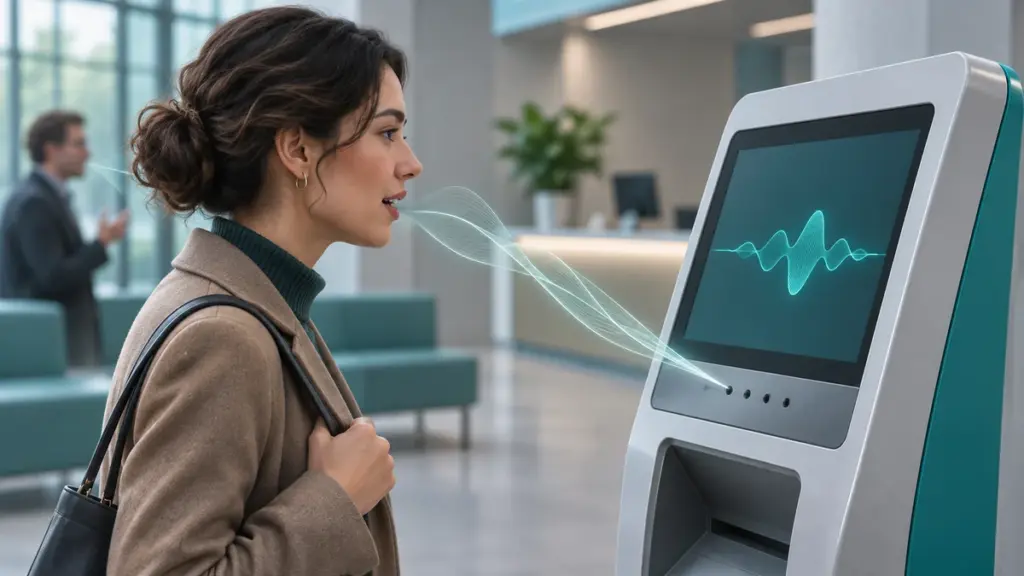
Audio array mic for voice kiosks: How to test speech capture
Test a microphone array for voice kiosks using realistic customer speech, competing talkers, loudspeaker playback, and recognition results in the...