

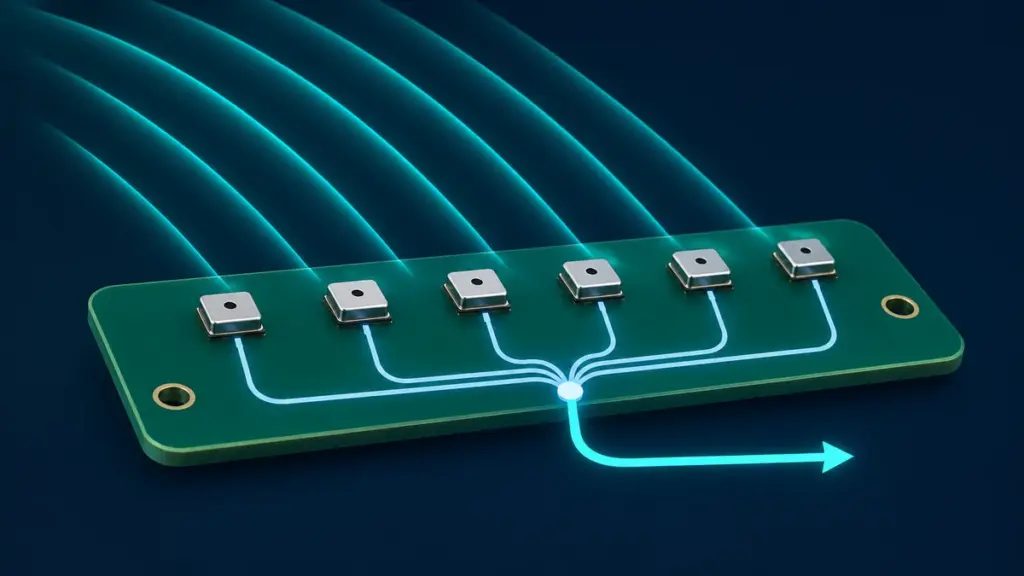
Mic array meaning: What is a microphone array and how does it work?
A mic array, short for microphone array, is a group of two or more microphone elements arranged at defined positions and used together to capture sound. Processing their signals can support directional pickup, speech enhancement, or sound-source localization. The available functions depend on the array design and its processing system.
Microphone arrays appear in laptops, conference devices, robots, and embedded voice systems. For engineers choosing a module, the first questions are what sound it needs to capture, where that sound comes from, and which audio signals the host can access.
What does “mic array” mean?
“Mic” means microphone. “Array” describes a coordinated arrangement of multiple elements.
Each microphone captures sound at a different physical position. Those positions create differences between the recorded signals, including differences in arrival time. A processing system can use that spatial information to change how the combined output responds to sound from different directions.
Three terms describe different parts of the system:
| Term | Meaning |
|---|---|
| Microphone element | An individual sensor that converts sound into an electrical signal |
| Microphone array | Multiple microphone elements used together in a defined arrangement |
| Microphone array module | An assembly for integration into a device; it may include capture electronics, a processor, and an interface |
The word “array” alone does not specify whether beamforming, noise suppression, or direction estimation is included. Check the processing functions and output modes of the particular device.
How does a microphone array work?
Imagine a person speaking toward a device with several spaced microphones. Their voice travels different distances to reach each microphone, creating small arrival-time differences.
A delay-and-sum beamformer compensates for the expected timing differences from a selected direction and combines the aligned signals. Sound from that direction adds coherently, while sound from other directions combines differently and may be reduced. Adaptive beamformers use adjustable filters or weights to control interference. Performance depends on the sound field and how accurately the system represents the desired source.
The microphones supply the spatial measurements. The processing determines how the system uses them.
Microphone array vs. single microphone
A single microphone can be suitable when the speaker stays close to a known position. An array becomes useful when the application needs spatial information or a pickup response formed from multiple sensors.
| Question | Single microphone | Microphone array |
|---|---|---|
| How many sensing elements are involved? | One | Two or more |
| What determines directional response? | The element and its acoustic design | The elements, their arrangement, and processing |
| Can it support electronic beam steering? | A single element does not provide the inter-microphone spatial measurements needed for array beamforming | Possible with a suitable array and processing implementation |
| How many channels does the host receive? | Depends on the device interface | May be raw channels, processed audio, or both |
| Is it automatically the better choice? | Evaluate it against the application | Evaluate the complete system, including processing and installation |
Physical microphone count and output-channel count are separate specifications. An eight-microphone device may combine its inputs into one processed voice channel. Another may expose eight raw channels for host processing.
An array also cannot guarantee that a distant speaker will sound clearer than a person speaking close to a suitable single microphone. Compare recordings under the intended operating conditions.
Is a microphone array omnidirectional or directional?
An array can use omnidirectional microphone elements and still produce a directional output. Each element receives sound broadly; processing combines the channels to favor selected directions.
When a module is described as “360°,” determine whether that means broad simultaneous coverage, selectable pickup directions, or source tracking around the device. These behaviors have different integration requirements.
For a directional module, ask how the pickup angle is defined, at which frequencies it was measured, and what happens outside that angle. A stated coverage angle does not establish uniform rejection across the entire speech band.
Beamforming, noise suppression, and AEC explained
These functions address different parts of voice capture:
| Function | Purpose |
|---|---|
| Beamforming | Shapes the spatial response by combining microphone signals |
| Noise suppression (NS) | Reduces unwanted noise in the captured audio |
| Acoustic echo cancellation (AEC) | Reduces the device’s loudspeaker playback captured by its microphones, typically using a playback reference |
| Automatic gain control (AGC) | Adjusts signal gain to manage changes in audio level |
| Direction-of-arrival estimation (DOA) | Estimates the direction from which sound reaches the array |
Beamforming, AEC, and noise reduction may operate together in a voice front end, but they perform different tasks. The Analog Devices technical discussion linked above explains why their interaction matters.
DOA output also needs separate confirmation. A device may produce directional audio without exposing direction data to the host.
What does “Microphone Array” mean on a laptop?
In a laptop’s sound settings, “Microphone Array” commonly identifies its built-in microphone system.
The device name does not tell you its physical microphone count, available raw channels, or supported beamforming controls. Those details depend on the computer and its audio implementation.
If your goal is to fix an input problem, follow our microphone array troubleshooting guide.
What should engineers check before choosing a mic array module?
Start with the required listening area and audio workflow. A fixed counter terminal and a robot that must detect a speaker’s direction need different evaluation criteria.
Define the pickup area
Record where speakers will stand, whether they move, and which competing sounds the device must handle. Specify the required working distance together with speaking level, ambient noise, and room conditions.
Treat pickup distance as a test condition to verify. A distance figure without an audio-quality criterion is difficult to use for engineering acceptance.
Check geometry and microphone count together
Microphone spacing, overall aperture, and layout affect the directional response across frequency. Adding microphones does not guarantee improvement at every frequency.
Request polar-response information across the required band, together with the processing mode used for each measurement. A single polar plot provides only a limited view of performance.
Confirm the host audio interface
Check the actual interface, channel mapping, sample rate, bit depth, and clock requirements. Do not assume that an interface label establishes the complete audio format or software compatibility.
For research and custom algorithms, verify access to separate microphone channels and their relative timing. For processed voice capture, confirm which functions run on the module and which remain the host’s responsibility.
Evaluate the installed assembly
Test with the intended housing, microphone openings, fans, and speakers in place. Include playback during voice capture when the device must support two-way conversation.
Useful supplier questions include:
- Can the host access raw microphone signals, processed audio, or both?
- Which processing functions can be configured or disabled?
- How does the device obtain its AEC reference?
- What conditions were used to measure pickup distance and directional response?
- Does the documented audio format match the intended operating system or embedded platform?
Use a repeatable comparison
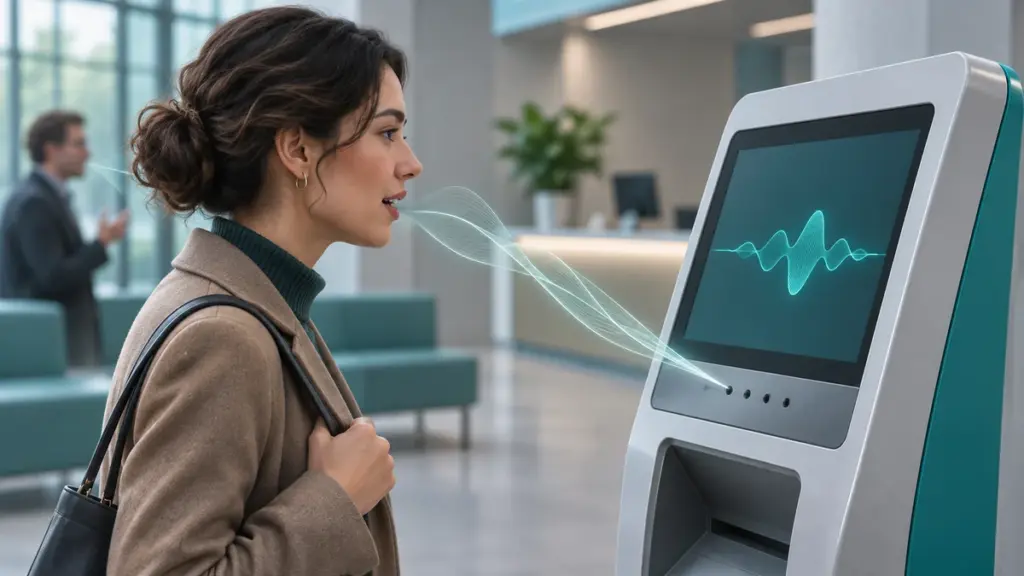
For a counter terminal, one evaluation could place a target speaker in front of the device and a competing speaker to the side. Repeat recordings at the required distances, with the fan running and with loudspeaker playback enabled where relevant.
Keep source positions, speaking levels, and processing settings consistent when comparing modules. Listen for missing words and processing artifacts. If the device feeds speech recognition, measure recognition errors on the same test material. This is a proposed evaluation method, not a claim about a particular product’s performance.
Explore HAOKAI microphone array modules
We offer omnidirectional array microphone modules and directional array microphone modules for device integration.
Compare the documented audio outputs, processing functions, and installation requirements for each model. Use the evaluation criteria above to check whether a module meets your application’s needs.
FAQs
What does mic array stand for?
Mic array is short for microphone array: two or more microphone elements arranged at defined positions and used together to capture sound.
What is a dual microphone array?
A dual microphone array uses two microphone elements. Its directional behavior and available processing functions depend on their arrangement and the system implementation.
Is a microphone array the same as a MEMS microphone?
MEMS describes a microphone sensor technology. An array describes how multiple microphone elements are arranged and used together. A microphone array can contain MEMS elements, but the terms describe different things.
Does every microphone array cancel noise?
No. Some arrays supply raw channels for external processing. Others include beamforming, noise suppression, or AEC. Verify the functions supported by the specific model.
Does an eight-microphone array output eight audio channels?
Not necessarily. It may output combined voice audio, separate microphone channels, or both. Confirm the interface’s channel count and output modes.
Are more microphones always better?
No. Microphone count is one design variable. Geometry, sensor matching, processing, and the acoustic environment also affect performance. Compare complete systems under equivalent conditions.
You May Also Like
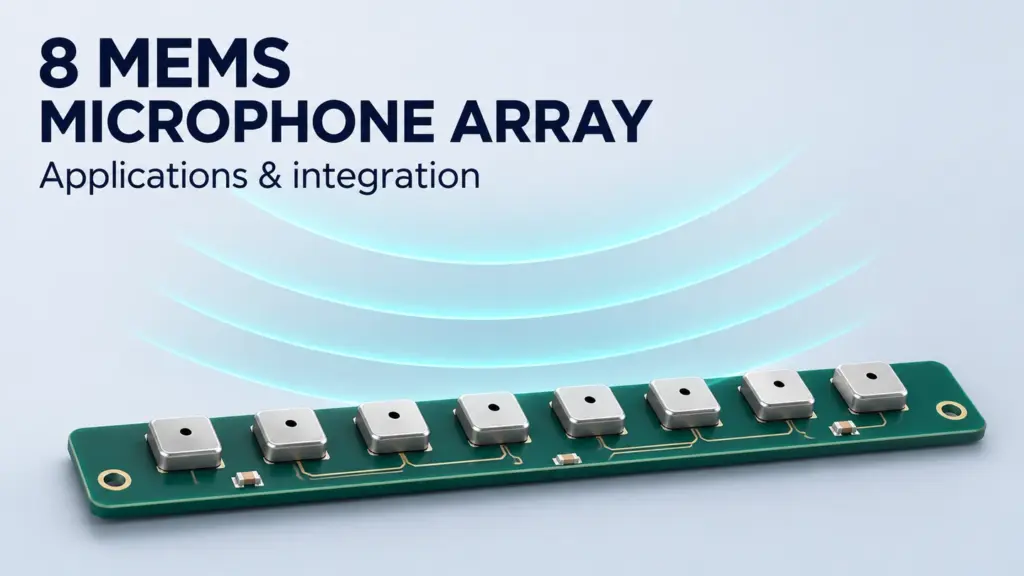
8 MEMS microphone array: applications and design considerations
Explore how an eight-element MEMS microphone array can support robotics, conferencing, voice control, and acoustic research, with practical guidance on...
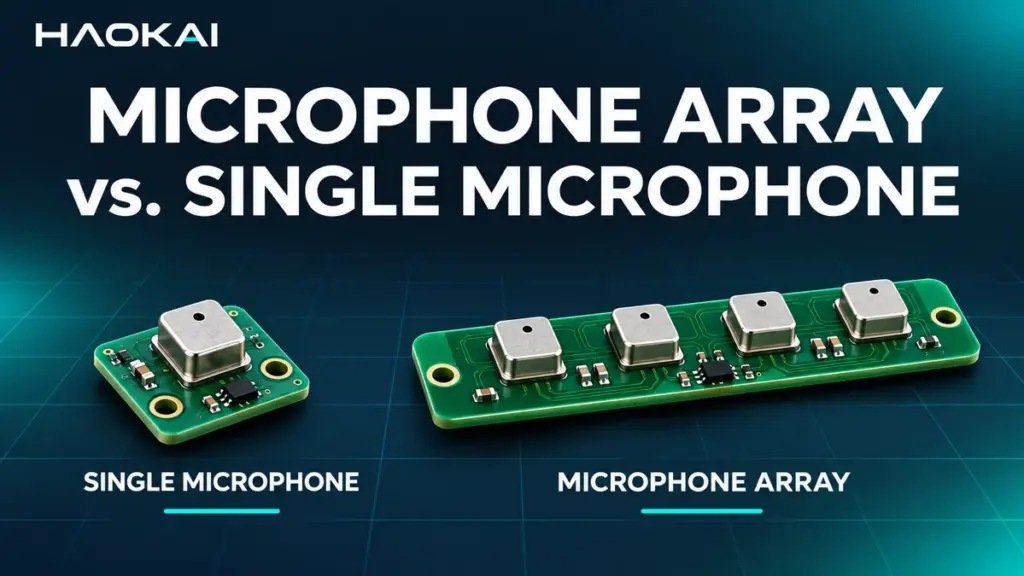
Microphone array vs. single microphone: What is the difference?
Compare microphone arrays and single microphones for embedded voice systems, including directional pickup, processing, host audio, and HAOKAI module selection.
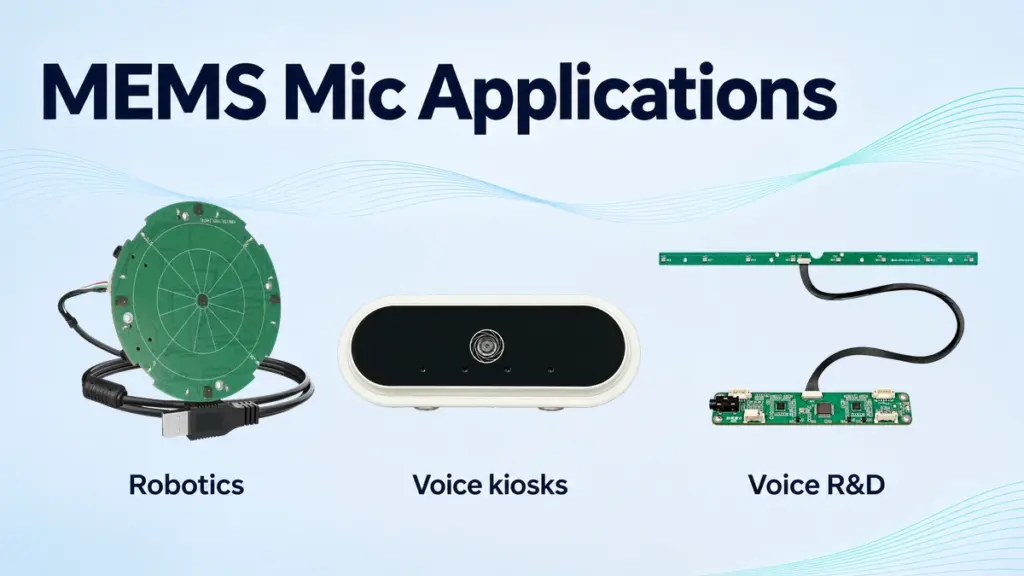
MEMS mic applications for robots, kiosks, and voice R&D
Compare three microphone array modules for service robots, voice kiosks, and acoustic research. See what output each application needs and...
Audio array mic for voice kiosks: How to test speech capture
Test a microphone array for voice kiosks using realistic customer speech, competing talkers, loudspeaker playback, and recognition results in the...