

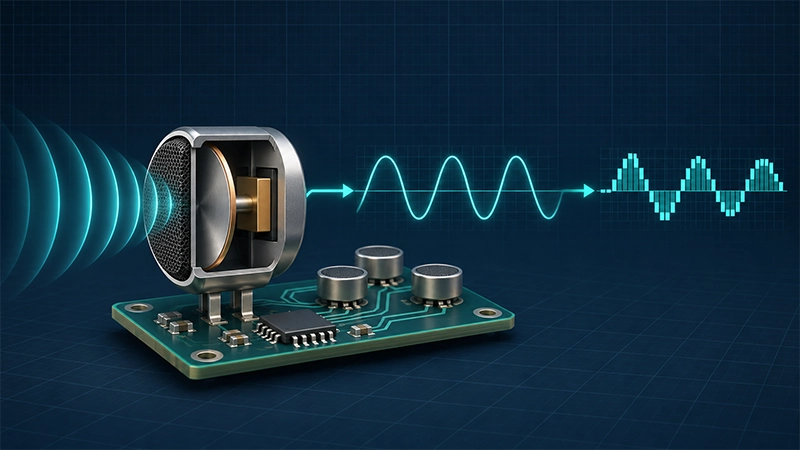
Microphone sensitivity explained: how to read dBV/Pa, mV/Pa, and dBFS
Microphone sensitivity describes the output a microphone produces when it receives a defined acoustic input. In practical terms, it tells an engineer how large the analog voltage or digital signal will be for a known sound pressure at the capsule.
A more sensitive microphone produces a larger output under the same test conditions. That can reduce the gain required later in the signal chain, but it does not prove that the microphone sounds better, reaches farther, rejects more noise, or has a wider dynamic range. Those questions require other specifications and, for an array module, a review of the complete acoustic and DSP system.
What does microphone sensitivity measure?
The common reference condition is a 1 kHz tone at 94 dB SPL, which equals 1 pascal of sound pressure. The microphone’s output under that condition becomes its sensitivity rating.
The word “output” depends on the microphone type:
- An analog microphone produces a voltage, commonly stated in mV/Pa or dBV/Pa.
- A digital microphone produces a digital amplitude, commonly stated in dBFS at 94 dB SPL.
- A USB microphone array module may include microphones, gain stages, an analog-to-digital converter, beamforming, automatic gain control, noise suppression, and other processing. Its observed USB output can therefore depend on more than the capsule sensitivity.
Sensitivity is a ratio between input and output. A specification written only as “-30 dB” is incomplete unless the reference, test level, frequency, and output point are defined.
How to read analog microphone sensitivity
Analog microphone sensitivity is usually expressed in mV/Pa or dBV/Pa.
mV/Pa
Millivolts per pascal states the output directly. A microphone rated at 10 mV/Pa produces 10 mV RMS when exposed to the stated 1 Pa reference signal, assuming the data sheet uses the standard test condition.
A larger mV/Pa value means a larger electrical output for the same acoustic input.
dBV/Pa
dBV expresses voltage relative to 1 volt. Because microphone outputs are usually well below 1 V at the reference condition, sensitivity values in dBV/Pa are normally negative.
The conversion is:
Sensitivity (dBV/Pa) = 20 × log10[sensitivity (V/Pa)]
To convert back:
Sensitivity (mV/Pa) = 1000 × 10^(dBV/Pa ÷ 20)
| Sensitivity in dBV/Pa | Equivalent output in mV/Pa |
|---|---|
| -20 dBV/Pa | 100 mV/Pa |
| -26 dBV/Pa | 50.1 mV/Pa |
| -30 dBV/Pa | 31.6 mV/Pa |
| -32 dBV/Pa | 25.1 mV/Pa |
| -40 dBV/Pa | 10 mV/Pa |
| -50 dBV/Pa | 3.16 mV/Pa |
| -60 dBV/Pa | 1 mV/Pa |
This table applies only when the original value is dBV/Pa. It must not be used to convert a dBFS value or a number whose reference is missing.
How to read digital microphone sensitivity in dBFS
Digital microphones often specify sensitivity in dBFS, meaning decibels relative to digital full scale. Full scale is the digital ceiling. A reference tone that produces -26 dBFS is closer to that ceiling than one that produces -30 dBFS.
Under the same test conditions, -26 dBFS represents 4 dB more digital amplitude than -30 dBFS. The amplitude ratio is about 1.58 to 1.
dBFS does not describe an output voltage, so it cannot be converted directly to mV/Pa. A valid conversion would require details about the analog front end, converter reference, gain, and digital scaling. In many digital microphone systems, the more useful engineering questions are how the reference signal maps to full scale, how much headroom remains, and where gain is applied.
Is -26 dB more sensitive than -30 dB?
It is, but only when both values use the same reference and test method.
For two ratings in dBV/Pa, -26 dBV/Pa is more sensitive than -30 dBV/Pa. It produces about 1.58 times the voltage for the same sound pressure. The same relative comparison applies to two dBFS sensitivity ratings measured under matching conditions.
The comparison is invalid when one value is dBV/Pa and the other is dBFS. It is also unsafe when a data sheet gives only “dB” without stating the reference. Check the full specification before drawing a conclusion from the negative number.
Microphone sensitivity and gain are different
Sensitivity is the microphone’s output for a defined acoustic input. Gain is amplification applied later.
A low-sensitivity microphone can reach the same final output level as a higher-sensitivity microphone if the signal chain adds more gain. The tradeoff depends on the noise and headroom of the complete system. Extra analog gain can raise preamplifier noise along with the microphone signal. Digital gain raises the stored signal level, but it cannot restore information that was lost below the system noise floor. Gain can also reduce the level at which the signal chain clips.
Automatic gain control adds another layer. AGC changes gain as the incoming level changes, so the level seen at a USB output may not track the nominal sensitivity in a simple, fixed way. When evaluating an array module, record whether AGC, noise suppression, echo cancellation, and beamforming are enabled during the test.
Is higher microphone sensitivity better?
Higher sensitivity is useful when the source is quiet or the available preamplifier has limited clean gain. It can help produce a healthier electrical level before later amplification.
Lower sensitivity can leave more output headroom for loud sources, depending on the microphone and signal-chain design. It may suit systems that must handle high acoustic levels without approaching clipping too early.
Neither choice guarantees better audio. Sensitivity scales the wanted sound and acoustic background together. A directional pattern, source-to-microphone distance, room acoustics, self-noise, signal-to-noise ratio, maximum SPL, and DSP behavior often matter more to the usable result.
This is especially important in far-field voice systems. A sensitivity rating measured at 94 dB SPL does not predict speech intelligibility several meters away. Sound level falls as distance increases, while reflections and ambient noise become a larger part of the captured signal. Array geometry, beamforming, microphone matching, and enclosure design all affect the outcome.
The specifications that should be checked with sensitivity
Signal-to-noise ratio and self-noise
Sensitivity tells you the signal level produced from the reference input. SNR or equivalent self-noise helps show how far that signal sits above the microphone’s own noise. Two microphones with similar sensitivity can have different noise performance.
Acoustic overload point or maximum SPL
The acoustic overload point, often shown as AOP, indicates how much sound pressure the microphone can handle before distortion reaches the manufacturer’s stated limit. A high output at the reference level is useful only if the system also has enough headroom for louder events.
Dynamic range
Dynamic range covers the useful span between the noise floor and the highest level the microphone can reproduce within its distortion limit. Sensitivity alone does not define that span.
Frequency response
Sensitivity is commonly measured at 1 kHz. A microphone can respond differently at lower and higher frequencies, so a single sensitivity value cannot describe its tonal balance or speech-band response.
Directivity
Omnidirectional and directional microphones may have similar nominal sensitivity while behaving very differently in a room. Directivity determines how the system weights sound arriving from different angles. Sensitivity determines the output for the defined input at the specified angle.
Channel matching in a microphone array
Array performance also depends on the consistency between channels. Sensitivity mismatch creates level differences across microphones, while phase and timing mismatch can affect spatial processing. Ask for channel-to-channel sensitivity tolerance, phase consistency, and any factory calibration method when these details matter to beamforming or localization.
Reading sensitivity on HAOKAI microphone array module pages
HAOKAI’s current product pages show several ways of presenting sensitivity. The following examples were reviewed on November 7, 2026.
| Model | Architecture and use | Sensitivity shown on the product page |
|---|---|---|
| M40 | 4-microphone omnidirectional USB array with onboard AEC, noise suppression, AGC, and beamforming | -30 dBFS |
| HK-ARRAYMIC-V3.2-8 | 8-microphone far-field module with onboard DSP | -30 dBFS |
| HK-ARRAYMIC-RAW-V1.0 | 8-channel raw-output linear array for host-side processing | -32 dB |
| HK-JZMIC-V1.0 | 2-microphone USB module with voice enhancement, noise suppression, and AGC | -30 ± 2 dB |
| HK-SDXMIC-V1.1 | 4-microphone dual-directional USB array with left/right separation and AGC | -26 ± 1 dB |
These examples show why the unit matters as much as the number. A complete module specification should identify the acoustic stimulus, reference frequency, output reference, tolerance, processing mode, and measurement point.
How to compare microphone sensitivity for a product design
Start by making the comparison electrically valid.
- Confirm that every value uses the same unit, reference pressure, frequency, and measurement convention.
- Separate capsule sensitivity from module-level output. Document any analog gain, ADC scaling, beamforming gain, AGC, or USB volume control.
- Estimate the acoustic level at the microphone in the intended installation, including normal speech, quiet speech, and the loudest expected event.
- Calculate the expected signal level before optional gain. For an analog microphone, the approximate output is
sensitivity in dBV/Pa + (input SPL - 94 dB). A -40 dBV/Pa microphone exposed to 74 dB SPL therefore produces about -60 dBV, or 1 mV. - Check that the preamplifier or digital path can supply the required gain without excessive noise and still retain headroom for peaks.
- Compare SNR, self-noise, AOP or maximum SPL, frequency response, directivity, and channel matching.
- Test the complete module in the intended enclosure. Port geometry, vibration, speaker coupling, reflections, and processor settings can change system performance even when the microphone specification is unchanged.
For a digital example, a microphone rated at -30 dBFS at 94 dB SPL would produce approximately -50 dBFS at 74 dB SPL before added gain or level-dependent processing, assuming a linear response. That estimate is a signal-budget starting point, not a prediction of recognition accuracy or pickup distance.
Common mistakes when comparing microphone sensitivity
- Treating a sensitivity value in dB as if it were an acoustic level in dB SPL.
- Assuming that a more negative number means higher sensitivity.
- Converting dBFS to mV/Pa without a defined analog and digital signal-chain mapping.
- Using sensitivity as a proxy for audio quality, background-noise rejection, or pickup range.
- Comparing a raw microphone channel with a processed USB output.
- Ignoring AGC or host volume settings during a bench test.
- Checking the nominal value while overlooking unit-to-unit tolerance and channel matching.
Use sensitivity as part of a complete signal budget
Microphone sensitivity is most useful when it is treated as an input to system design. It helps engineers estimate signal level, gain, noise, and headroom. It does not replace acoustic testing or the rest of the data sheet.
When comparing an array module, verify the sensitivity reference first, then evaluate SNR, AOP, directivity, processing modes, channel matching, interfaces, and performance in the intended enclosure. You can review HAOKAI’s omnidirectional array microphone modules and directional array microphone modules as starting points for that comparison.
FAQs
What is a good microphone sensitivity?
There is no universal target. A suitable value produces enough signal for the expected sound level and available gain while leaving adequate headroom for louder inputs. Quiet far-field sources and high-SPL sources place different demands on the signal chain.
Is -26 dB more sensitive than -30 dB?
Yes, if both ratings use the same reference and test conditions. The -26 dB value represents about 1.58 times the output amplitude of -30 dB. If the units or references differ, the numbers should not be compared directly.
Does higher sensitivity mean more background noise?
Higher sensitivity produces a larger output for every acoustic signal reaching the microphone, including wanted sound and room noise. It does not selectively capture background noise. Microphone placement, directivity, room acoustics, SNR, and processing determine how much background remains in the usable signal.
Can microphone sensitivity predict pickup distance?
No. Sensitivity is measured at a defined sound pressure at the capsule. Pickup distance also depends on source level, room noise, reflections, array geometry, directivity, beamforming, processing, and the level of intelligibility required by the application.
What is the difference between microphone sensitivity and input gain?
Sensitivity is a microphone or module characteristic measured from a defined acoustic input. Input gain is amplification applied after the microphone produces its signal. Gain can change the final level, but it cannot improve the acoustic signal-to-noise ratio that already exists at the microphone.
You May Also Like
8 MEMS microphone array: applications and design considerations
Explore how an eight-element MEMS microphone array can support robotics, conferencing, voice control, and acoustic research, with practical guidance on...
Microphone array vs. single microphone: What is the difference?
Compare microphone arrays and single microphones for embedded voice systems, including directional pickup, processing, host audio, and HAOKAI module selection.
MEMS mic applications for robots, kiosks, and voice R&D
Compare three microphone array modules for service robots, voice kiosks, and acoustic research. See what output each application needs and...

Audio array mic for voice kiosks: How to test speech capture
Test a microphone array for voice kiosks using realistic customer speech, competing talkers, loudspeaker playback, and recognition results in the...